






Do you feel swelling in your neck or thyroid area? Maybe you're having symptoms of fatigue, or maybe you've gotten some thyroid lab results back and you're wondering how to diagnose Hashimoto's disease. In this article we're going to look at that question — what specific lab tests you need to diagnose Hashimoto's, and some of the different ways it can present itself, to give you a better understanding of how we actually make the diagnosis.
What Hashimoto's Actually Is
Hashimoto's disease, also known as Hashimoto's thyroiditis or chronic lymphocytic thyroiditis, is by nature an autoimmune disorder: lymphocytes — types of white blood cells — are inflaming and attacking the thyroid gland. In the U.S. and other developed nations, this is the most common cause of hypothyroidism, or underactive thyroid.
The thyroid is a small butterfly-shaped gland that sits right in the neck and produces thyroid hormones like T3 and T4. So when we want to diagnose Hashimoto's, we need to look at both thyroid function and autoimmune activity.
Signs And Symptoms First
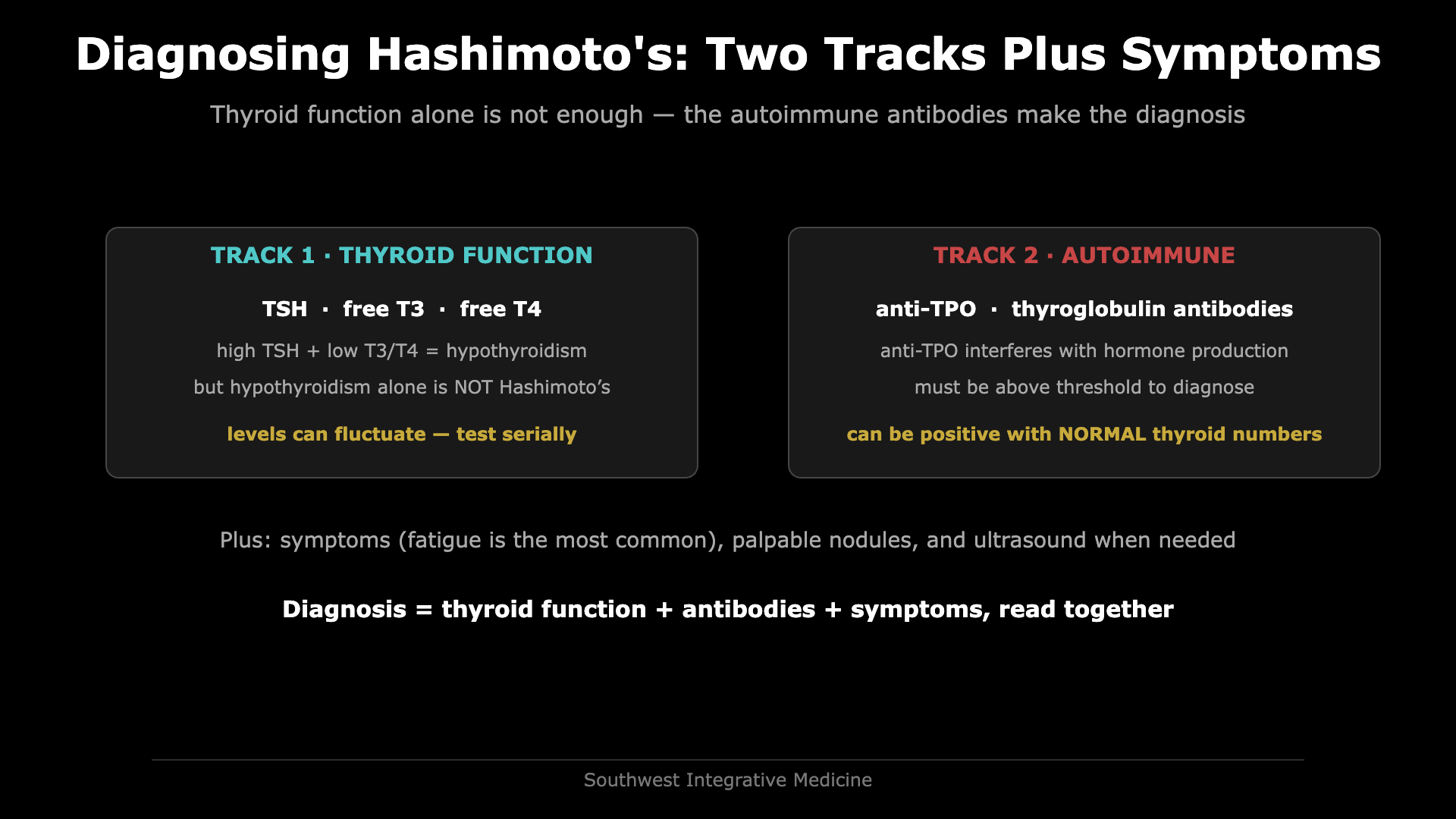
It's important to do a thorough intake and understand what symptoms the person is having — one of the most common is fatigue. On physical exam, a lot of the workup happens through blood testing, but sometimes you can also feel nodules along the thyroid gland, which may be an indicator that something is going on with the thyroid.
The Thyroid Function Tests: TSH, Free T3, Free T4
The tests we use to look at thyroid functionality are TSH — thyroid stimulating hormone — and T3 and T4, the thyroid hormone output from the gland. Most of what the thyroid produces is T4, so that's one of the more important ones to measure, but both T3 and T4 can be low, so it's good to measure both. You also want the free, bioavailable versions of these tests, because that gives you a better indicator of the active amount of thyroid hormone.
High TSH with low T3 or T4 can indicate hypothyroidism, and that's really common with Hashimoto's. But the presence of high TSH or low T3 and T4 isn't enough to diagnose Hashimoto's — you can have hypothyroidism without Hashimoto's. How high the TSH is and how low the T3 and T4 are will determine how treatment moves forward.
The Autoimmune Tests: Anti-TPO And Thyroglobulin Antibodies
For the autoimmune part of the diagnosis, you're looking at anti-thyroid peroxidase — the anti-TPO antibody — which is the most commonly used to diagnose Hashimoto's, and sometimes thyroglobulin antibodies as well. Anti-TPO is the most telling because it interferes with the production of the thyroid hormone itself, while anti-thyroglobulin has more to do with transport. Both are indicators of autoimmune disease.
The antibodies need to be above a certain threshold to make the diagnosis. Some of us have small amounts in our body without enough to trigger a positive result — but when they're high above that threshold, that's Hashimoto's thyroiditis.
You Can Have The Antibodies With Normal Thyroid Numbers
It's also possible to have Hashimoto's antibodies in your blood and not have hypothyroidism — TSH, T3 and T4 all look really good. But if the autoimmune component is present, your immune system is still interfering with thyroid hormone production. Because that interference is inconsistent, your hormone levels can fluctuate: check your blood one day and the levels may be different a day later.
So if your symptoms seem to fluctuate a lot, it may be important to get multiple serial tests before you make a decision about starting thyroid hormone.
Imaging
An ultrasound can also be used to image the thyroid — bouncing sound waves off the gland gives a better view of whether nodules are present, which can be an indicator of inflammation in the thyroid.
Putting It Together
The diagnosis of Hashimoto's disease is typically made through a combination of lab testing — thyroid function plus the autoimmune antibodies — together with your symptoms. If the pieces don't line up neatly, serial testing over time is often what clarifies the picture.
Related reading: How To Cure Hashimoto's Disease and our thyroid treatment program.
If your thyroid labs and symptoms are not adding up, schedule an appointment and we can run the full panel properly.