






Do you have ongoing fatigue and trying to understand how it might relate to Epstein-Barr virus? In this video we're going to look at how to read Epstein-Barr virus test results. We'll look at what some of the positive antibodies mean, how to understand this in the context of your symptoms, and we'll look at some case studies that will help you better understand what might be going on with your Epstein-Barr virus test results.
What Epstein-Barr Virus Test Results Measure
So the first thing is, Epstein-Barr virus test results typically involve several different measurements of antibodies, and these measurements provide us information about the current activity of the virus in the body at the time of the blood draw. The antibody based test is the most commonly used, so that's what we're going to focus on here in terms of looking at and reading Epstein-Barr virus test results.
Now, because there are several different antibodies that can be tested, and that usually are included in this test, confusion often arises, even amongst doctors, as to what they actually mean. So in this video on how to read Epstein-Barr test results, I'll show you a hypothetical result and how you might look at them. We'll also look at a simple way to understand them, and a more nuanced way to look at and understand the results.
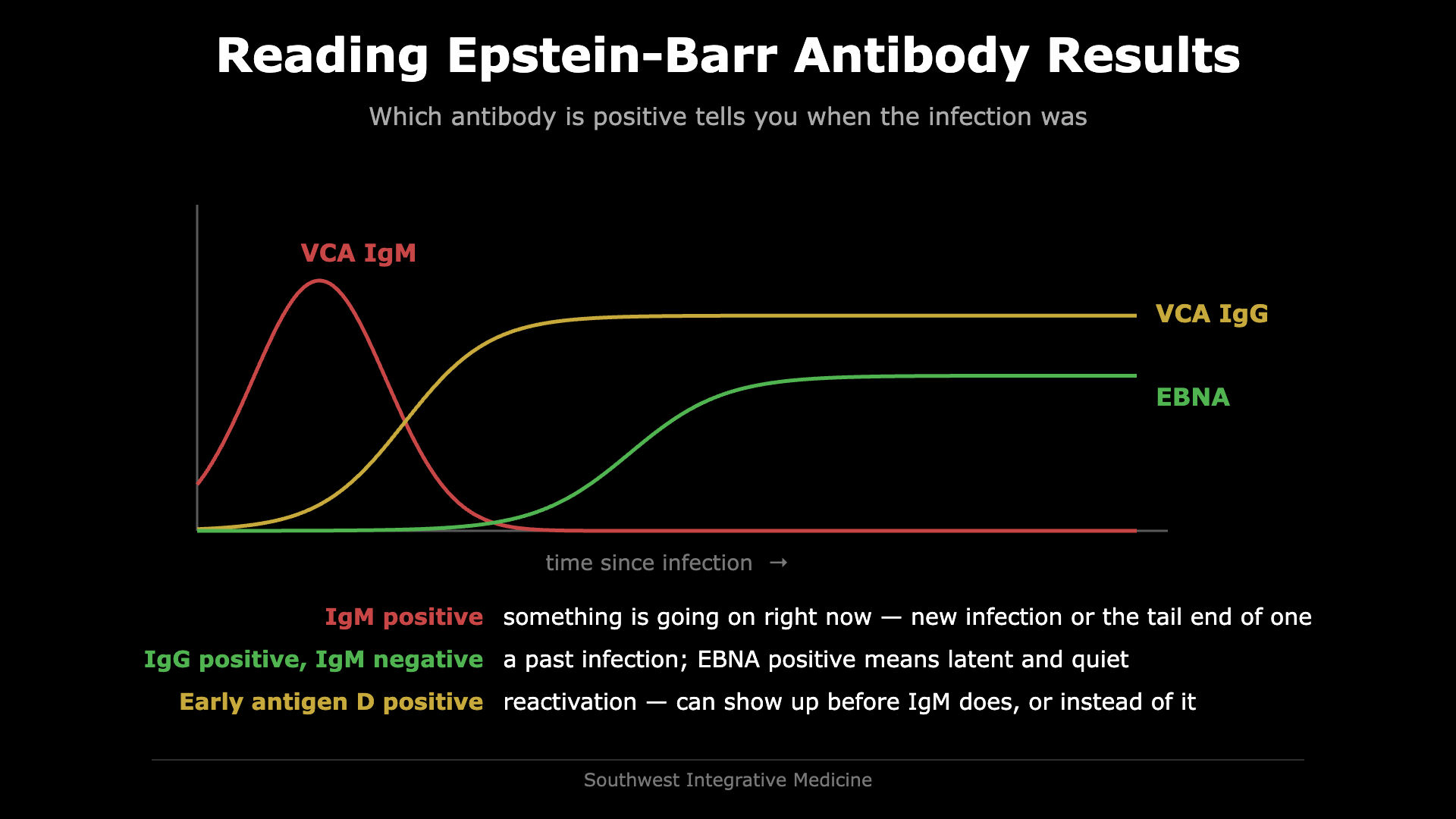
EBV antibody tests measure the level of antibodies of the virus in blood. If you've been infected with the Epstein-Barr virus, your body's going to produce different amounts of antibodies, and different antibodies at different time intervals, as that infection progresses. In addition, each one of those antibodies can remain in your body at different time intervals, sometimes months, sometimes years, and there is variance among individuals on how long each of these antibodies might stay in your body. And that's part of the confusion with interpreting the results as well.
The Simple Version: IgM Versus IgG
The antibody tests generally are measuring an IgM and an IgG antibody. A positive result for IgM is almost always indicative of a current Epstein-Barr virus infection, meaning you have it right now, or you are on the edge of getting over it, maybe in the next month, maybe two months. On the other hand, a positive IgG test result without the corresponding positive IgM is usually associated with the past or previous infection of Epstein-Barr.
So that's a simple version of how to look at it. Now, in looking at all the different types of IgG antibodies, that's where some of the confusion arises, because some of them actually can indicate a re-emergence of the virus before you actually see the IgM antibody, or sometimes you won't even see the IgM antibody at all.
A Hypothetical Result That Shows Current Activity
In looking at how to read Epstein-Barr test results, it's important to look at some hypothetical examples here, and this one I thought illustrated a more simplistic result that you might find, where there's clearly something going on with the Epstein-Barr virus in this person.
Anytime the IgM is positive, that's always going to be an indicator of something current going on with that virus, whether it's a recent infection going on and they're actively going through symptoms, or it's on its tail end. Sometimes you'll even see this with a positive like this for someone that has had the virus in the past and they're going through a new wave of re-emergence of that virus, and the replication of that virus needs to be suppressed so the immune system can get it in check.
You'll see on this that it's stated as equivocal, and that's because it didn't reach the actual threshold for being positive, which is 1.1. But even the 1.0, or equivocal, is an indicator of a re-emergence of that virus from its dormancy, or a new infection.
Now the presence of the early antigen D being positive like that also indicates the new activity of that virus, because the early antigen D is an early sign of infection or reactivation of the Epstein-Barr virus. So if you didn't have this, it would be less of an indicator of a current infection. But the presence of this alone, even with this being negative, could also be an indicator. You always have to understand what's going on in the context of the person to really get the most out of these tests. So again, no one test tells us everything. You have to look at sometimes multiple tests, also in the context of the person's history and what's currently going on with that.
A Result That Points To A Past Infection
Now this result is more of an indicator of a past infection. You'll see that the IgG are positive here and the IgM is negative. The nuclear antigen is almost always, when that's positive, going to be the result of a past infection or a latent infection. So you've had the virus, the immune system's fought it off, it's no longer producing symptoms in the person, when you just have the nuclear antigen positive.
The viral capsid IgG can go either way. Sometimes it can be an indicator of just the past infection simply, sometimes it could be an indicator of a current infection. How do you know? Well, you check the other ones as well, and also interpret it in the context of the person. Sometimes it's simply just a judgment call based on what's going on with the person and how they're presenting.
Fatigue And The Context Of The Person
Of course one of the most common symptoms with Epstein-Barr virus, or mono, is fatigue, and fatigue can be very non-specific. Lots of things can cause fatigue. So in some cases one of the things you want to do is make sure everything else is the way it should be, that there's no other possible contributing factors to that fatigue.
And that's why, of course, when you're trying to get a better understanding of what's going on with your body in the context of Epstein-Barr virus test results, you always want to get input from your doctor, because they're going to know the most about what's going on with you, and you overlap that with the test results and come to the best option for you in treatment and what to do to move it forward for your health. And this is mostly important when there's not a clear indication that that IgM is positive.
If you're dealing with ongoing fatigue and confusing EBV results, schedule an appointment and we can go through your panel together.
Topics: Epstein-Barr Virus, EBV Test Results, IgM Antibodies, IgG Antibodies, Early Antigen D, Nuclear Antigen, Chronic Fatigue