Are you looking at your blood tests and seeing you have really high ferritin and low iron saturation, and wondering why? In this post we'll break down what's actually going on in your body when you see this pattern — and why it's the immune system at the center of it.
The Two Numbers, Briefly
Iron is carried throughout the body on a carrier protein called transferrin. As iron rises, transferrin becomes more saturated — that's iron saturation. Ferritin, on the other hand, is the storage form of iron. It's a way the body holds iron for use later, and it's also a way to protect the body from iron when levels are high in circulation.
In most situations, these two numbers move together. If you're consuming a lot of iron in your diet, your iron saturation will be normal-to-high and your ferritin will be normal-to-high. They rise in parallel.
So Why Would Ferritin Be High And Saturation Low?
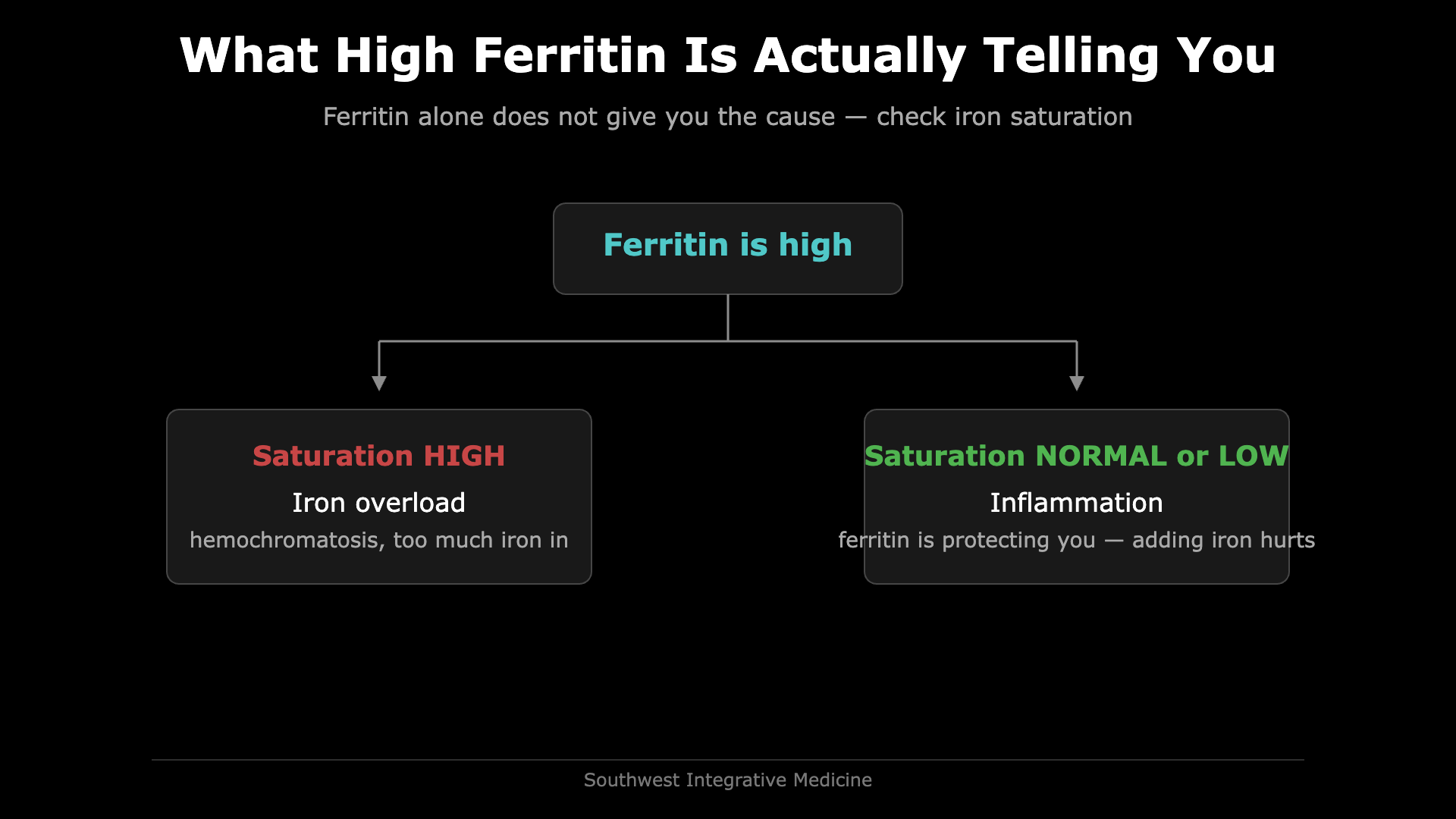
The main reason for the high-ferritin / low-saturation pattern is an inflammatory process going on in the body. Most often it's an infection — but it can also be autoimmune disease, bacterial infections, fungal infections, and similar conditions.
Here's the mechanism. When an infection is present, the body sequesters iron so that the iron is no longer available for the bugs to grow and proliferate. Iron in particular helps bacteria and other pathogens grow, so locking it up is a defense mechanism. The body scavenges up iron from circulation and stores it in ferritin. The result: ferritin goes up (more iron in storage) while iron saturation goes down (less iron available on transferrin).
This is driven mainly by the immune system — chemical messengers from the immune system trigger this redistribution.
Why You Don't Just Take Iron In This Situation
In situations like this you can have low hemoglobin and low red blood cells alongside the high ferritin and low saturation. The instinct might be to take an iron supplement to fix the anemia. Don't.
Two reasons. First, supplementing iron isn't really going to increase your hemoglobin and red blood cells, because the new iron will just get scavenged up into ferritin again. Second, more iron can further inflame the body — and if there's an active infection, it can actually help promote that infection and make it harder for the immune system to clear the bug.
Step one in this pattern is to check for inflammation and look for autoimmune conditions. Don't load iron until you've sorted out what's driving the sequestration.
It Can Also Be Temporary
Sometimes this pattern is just a temporary response to an active infection. During severe COVID-19 infections, for example, ferritin levels were reaching 700 to 800 and sometimes higher in patients — alongside anemia (low hemoglobin, low red blood cells) and low iron saturation. Once the infection cleared, the levels quickly normalized.
So a single high-ferritin / low-saturation reading during or just after an illness might mean nothing more than your body responding to that illness. If the pattern is lingering on multiple blood tests, that's when you want to find and clear whatever infection or autoimmune process is driving it.
Conclusion
The actual reason for the high-ferritin-with-low-iron-saturation pattern is your immune system sequestering iron away from a bug or an autoimmune driver. Treating it like iron overload is the wrong call. Treating it as iron deficiency anemia and supplementing iron is also the wrong call. The right move is to find and address the underlying inflammation source.
If you've got the high-ferritin / low-iron-saturation pattern and want help running the right workup — checking for infection, autoimmune drivers, and confirming whether the pattern is lingering — work with me directly.