







If you had mono months ago and your EBV IgM antibodies are still positive, or worse, still climbing, it's natural to wonder what's going on. This came up from a reader who had mono four months earlier, retested, and found their IgM antibodies hadn't just lingered, they'd increased. In this post we'll walk through what high or rising EBV IgM means, how long these antibodies normally stay up, how your symptoms help interpret the number, and when it actually points to chronic Epstein-Barr.
What High EBV IgM Actually Signals
Elevated or high EBV IgM antibodies point to one of three things. First, an acute Epstein-Barr infection, the virus is active right now. Second, a reactivation, the virus had gone dormant and is coming back. Third, lingering antibodies from a recent acute infection, where the infection is fading but the IgM hasn't cleared yet.
That third scenario is common and often misread. After your body has already started overcoming the virus, the antibodies can stick around for a couple of months. So a positive IgM doesn't automatically mean the infection is still raging, it may just be the tail end. For the broader question of whether the virus is currently active, see how to tell when EBV is active.
How Long IgM Normally Stays Up
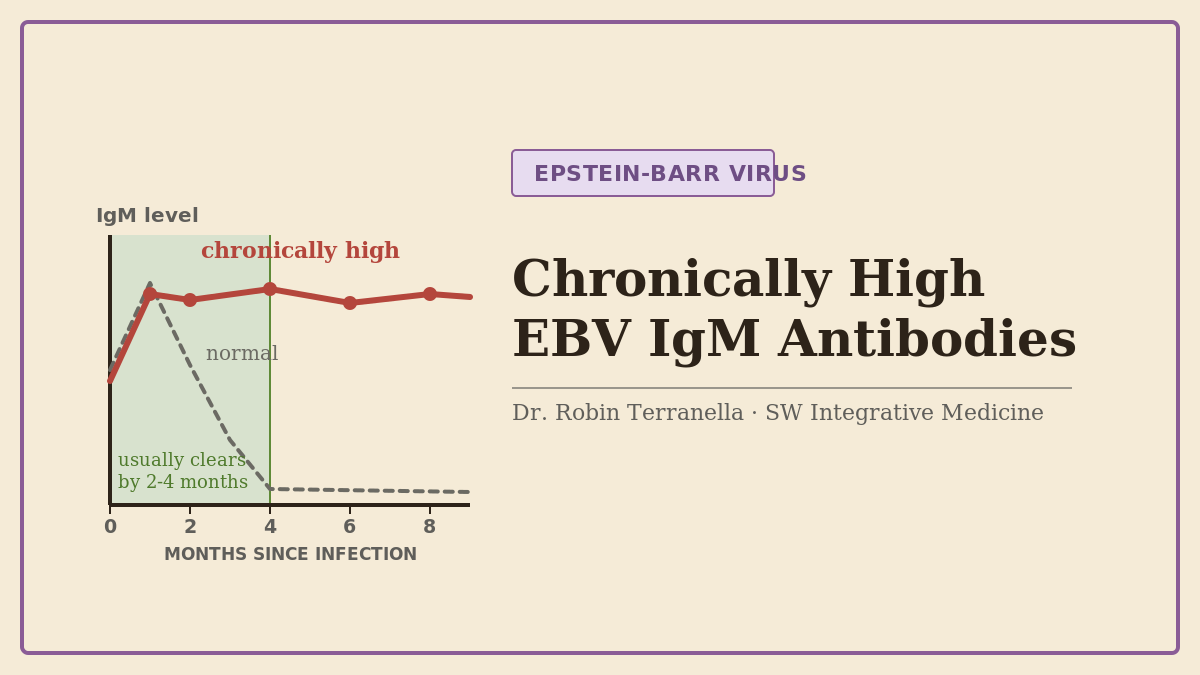
Typically, IgM antibodies stay high for a few months after the infection. Four months is getting toward the long end of that window. So if you're at four months and the number actually went up rather than down, that does suggest the process is running longer than we'd usually expect.
But it's not a reason to panic. These numbers can shift quickly. Even a value that just increased can be on its way down a week or two later. One snapshot in time tells you less than the trend across a couple of retests.
Let Your Symptoms Interpret the Number
This is where your symptoms do a lot of the work. If you still have fever, swollen lymph nodes in your neck or elsewhere, an enlarged spleen (which takes imaging to confirm), or severe fatigue, the kind where it's hard to get out of bed, that suggests your body is still actively fighting the virus and the infection is genuinely ongoing.
On the other hand, if you're largely asymptomatic, or simply getting better week by week, that points the other way: the virus is on its way out, and what you're seeing on the lab is just lingering antibodies. There's also an in-between phase where you're improving but the antibodies are hanging on longer than they usually would.
Why People Respond So Differently
A typical EBV or mono infection lingers symptom-wise for about a month or two, then starts to ease. But the range is wide. Some people are over it in a couple of weeks. Some never have a noticeable acute infection at all. That variation likely comes from a mix of your own genetics and the genetics and virulence of the particular virus. The honest answer is that we don't fully know why some people clear it fast while others reactivate.
When It Becomes Chronic EBV
Sometimes IgM antibodies stay high for six months, twelve months, or even several years. Once it pushes past about six months, that's generally when we start calling it chronic Epstein-Barr virus.
One thing worth understanding: Epstein-Barr is a herpes-family virus. Once you've been exposed, that kind of virus lives in your body for good, which is why your IgG test will stay positive permanently. The IgM is the one that normally turns negative within two to four months. Give it a margin of error of a few weeks to a month, since everyone clears it a little differently.
How Chronic EBV Is Actually Diagnosed
Diagnosing chronic EBV is far from black and white. There's no single number that settles it. It takes a combination: lab testing across the relevant antibodies, your current symptoms (which may be waxing and waning), ruling out other conditions that could explain how you feel, and the long-term overall clinical picture. If you want help reading the full antibody panel, the post on what a positive Epstein-Barr test means breaks the markers down.
Bottom Line
High or rising EBV IgM after mono isn't automatically alarming. It can mean active infection, reactivation, or just antibodies that haven't cleared yet, and your symptoms are the best guide to which. IgM usually fades within two to four months; past six months it leans toward chronic EBV. Track the trend, not a single result, and weigh it against how you actually feel.
If you're dealing with ongoing fatigue and a confusing EBV panel and want help interpreting it, work with me directly to build a plan around your specific labs and symptoms.
Topics: EBV, Epstein-Barr Virus, IgM, Chronic EBV, Mono, Fatigue, Antibodies