







If you're starting testosterone replacement therapy or you've been on it for a while, you've probably wondered whether TRT is going to raise your PSA — and if so, whether that's something you should worry about. Short answer: yes, testosterone almost always raises PSA given enough time. The longer answer involves the actual mechanism, the timeline I see in patients, and a few situations where PSA might not budge at all. Let's walk through it.
The Short Answer: Yes
Testosterone almost always raises PSA, given enough time. There are some small studies showing PSA doesn't rise on testosterone administration, but the better-designed studies do show PSA going up after TRT starts. In my own practice, I commonly see PSA rise after a patient starts TRT.
That doesn't mean every patient sees a dramatic jump. And it doesn't happen instantly — give it enough time, because one shot or one month usually isn't going to move the number meaningfully. But over the course of months, the trajectory is up.
Why It Happens — The Mechanism
PSA stands for prostate specific antigen. The "antigen" piece is just a fancy word for a protein. PSA is a protein produced by prostate tissue. So the amount of PSA in your blood largely reflects the amount of prostate tissue you have. More tissue = more PSA.
Where TRT comes in: testosterone increases the body's production of two other hormones that act directly on prostate tissue — estradiol and dihydrotestosterone (DHT). Both of these cause prostate cells to grow and divide, producing new prostate cells. More cells, more total prostate tissue, more PSA. That's the chain.
This connects to a broader point: with age, both PSA and prostate size generally increase. Some of that natural rise is thought to reflect lifelong exposure of prostate tissue to testosterone, DHT, and estradiol. Adding exogenous testosterone accelerates that exposure.
The Timeline I See In Practice
The pattern I see most commonly: an initial spike a few months after starting TRT, then a stabilization. After the early rise, PSA tends to settle into the normal age-trajectory line and continues climbing slowly with age — much like it would have without TRT, just from a slightly higher starting point.
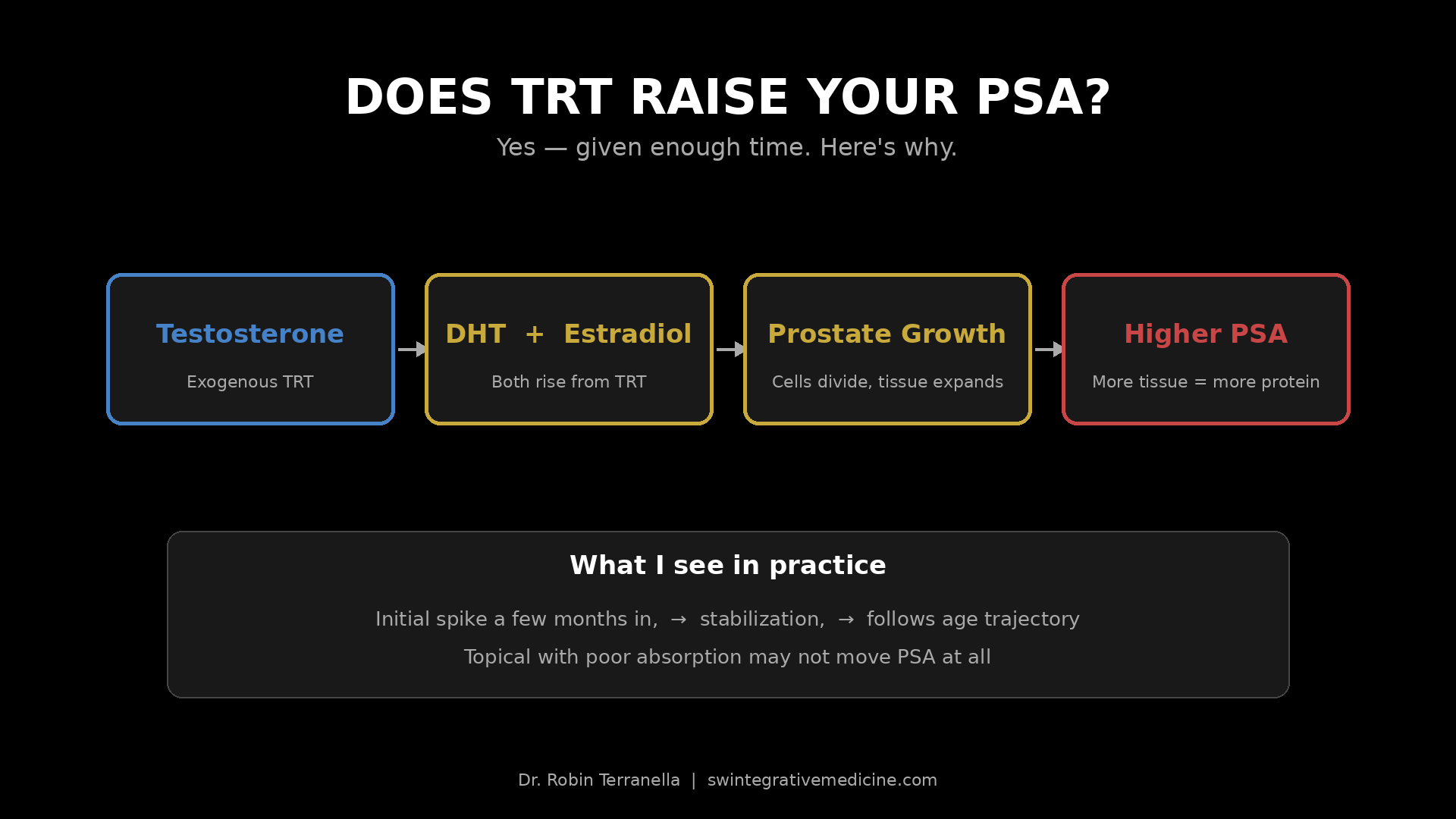
So the question isn't really "will TRT permanently elevate my PSA" — it's more like "will TRT push my PSA up to where age-related rise was going to take it anyway, faster." For most patients on a stable, monitored protocol, the PSA finds its new baseline and behavior tracks normally from there. It might rise again gradually over the next two to three years, then stabilize again.
The Topical Exception
One scenario where TRT may not raise PSA at all: poorly absorbed topical testosterone. If you're applying testosterone cream and a meaningful fraction isn't actually getting into your bloodstream — which is a common problem with topicals — your hormones may not actually be moving much. No real testosterone elevation means no real DHT or estradiol elevation, which means no real prostate effect.
So if you're on a topical and your PSA isn't budging, that may be reassuring on the prostate side — but it should also raise the question of whether the testosterone is doing anything at all. Patients on topicals who aren't feeling the expected changes in energy, libido, and recovery often have an absorption problem, and the unchanged PSA can be a clue. The fix is usually to switch to injectable or to address whatever's blocking absorption.
What This Means For Monitoring
If you're on TRT, expect PSA to rise. That's normal and not by itself a sign of a problem. What matters is the pattern:
- Initial rise then stabilization over months — typical, expected, generally fine
- Slow age-related rise after stabilization — typical, just track it
- Sudden or rapid rise after a previously stable period — that's worth investigating with your doctor; a urology workup may be indicated
- No change at all on a topical — possible absorption problem; check whether the TRT is actually working
The "does PSA even matter" debate — whether routine PSA screening is the right approach in the first place — is a separate question worth its own discussion. What this post is about is the relationship between TRT and the number itself.
Bottom Line
Yes, testosterone affects your PSA. Almost always up, given enough time. The mechanism is straightforward — more prostate tissue produces more PSA, and TRT drives the hormones that grow prostate tissue. The pattern is usually an initial spike, then stabilization on the normal age-trajectory. Topical testosterone with poor absorption may not move PSA at all — which can be a hint the TRT itself isn't working. Don't assume any rise is a problem; do track the pattern, and don't ignore sudden changes after a stable period.
For a complete protocol on starting and managing TRT — including how to interpret PSA, hematocrit, and estradiol changes — check out the Mastering Your TRT ebook or use the TRT Optimization App. Or work with me directly for a personalized plan.
Topics: TRT, Testosterone, PSA, Prostate, DHT, Estradiol, Men's Health