







If you're looking at your blood work and seeing your folate level flagged as "high," you might be wondering whether that's a problem. The short answer: no, in almost all cases it's not. The longer answer involves understanding what the standard serum folate test is actually measuring (and not measuring), why almost everyone runs high, and which folate test is more useful if you actually want to know your status. Here's the breakdown.
Most People Run "High" — And It's Mostly Meaningless
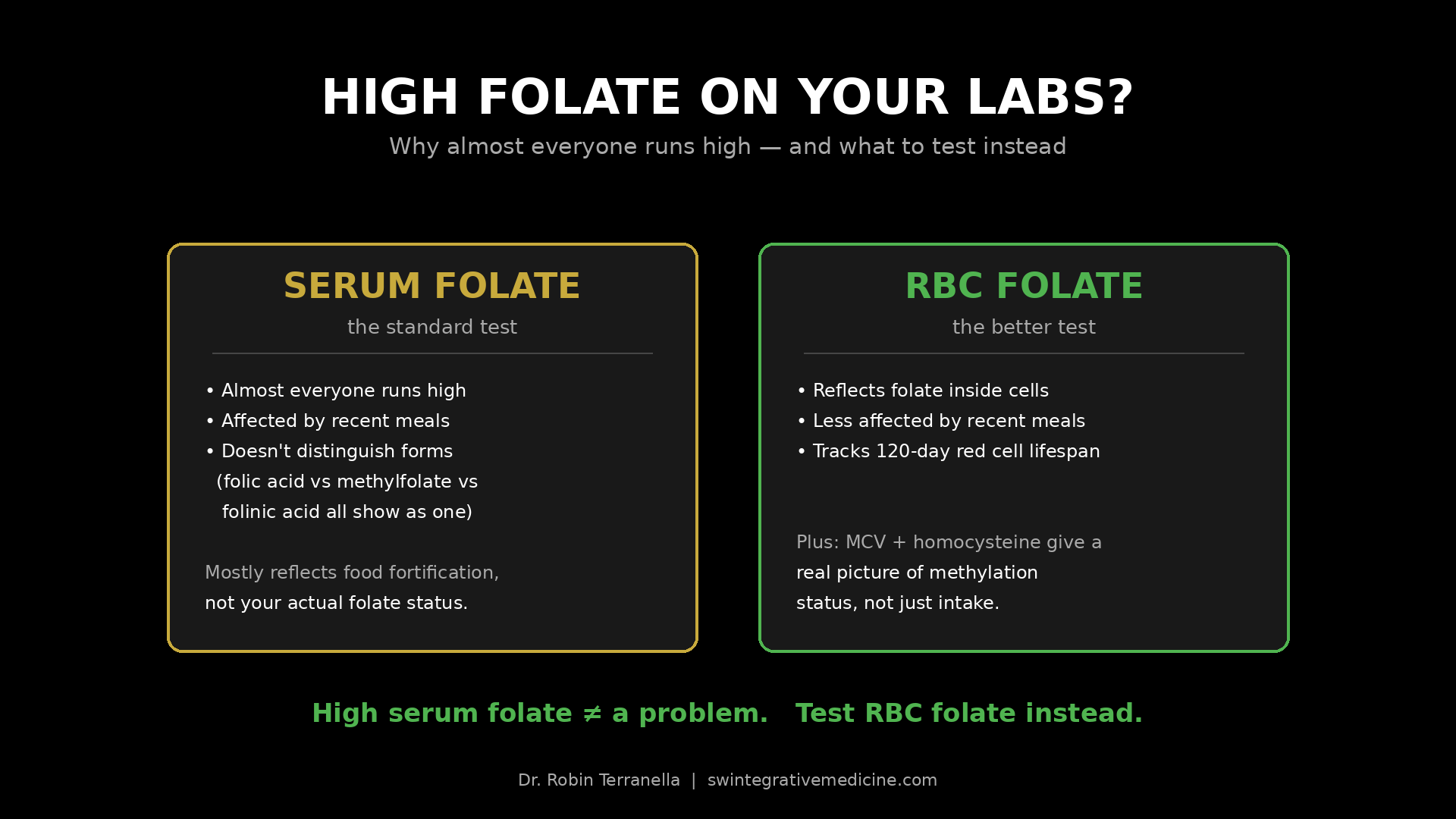
The standard folate test is a serum folate. Almost everybody has an elevated serum folate level. Honestly, in clinical practice I don't think I've ever seen one that wasn't on the high side. So when "high" is the default for the entire population, the result loses its diagnostic value.
The reason it runs high in almost everyone is straightforward: folic acid is everywhere in the modern food supply. Rice, breads, cereals, pastas — most grain-based foods are fortified with folic acid. Add a multivitamin (most contain folic acid) or any folate supplement and the number climbs further. So a "high" serum folate mostly reflects ambient food fortification, not your underlying status.
The Test Doesn't Distinguish Between Forms
Here's the bigger limitation: the standard serum folate test doesn't distinguish between folic acid, methylfolate, folinic acid, and the various intermediary metabolites. It just gives you one number for "folate." But these forms behave very differently in the body.
- Folic acid is synthetic. It needs to be converted in the liver to be useful. People with MTHFR variants can struggle with this conversion.
- Methylfolate (5-MTHF) is the active form your cells actually use.
- Folinic acid (5-formyl-THF) is another reduced form that's used in certain pathways.
So a high serum folate could mean you're getting plenty of usable methylfolate — or it could mean your serum is full of unconverted folic acid your cells can't actually use. The test alone doesn't tell you which.
Is High Folate Actually Dangerous?
There's a theoretical concern about high folate masking B12 deficiency — meaning the high folate can correct the anemia of B12 deficiency on labs while neurological damage continues underneath. That concern is real, but only matters if you actually have a B12 deficiency. If your B12 is adequate, high folate isn't a problem in itself.
The more practical caution: large doses of methylfolate can cause real symptoms in some people — agitation, anxiety, headaches, sleep disturbances. Read more on methylfolate side effects here. Folic acid doesn't seem to cause those same symptoms in the same way. So if you're considering supplementing with methylfolate specifically, start low — much lower than people often think.
The Better Test: RBC Folate
If you want a more accurate measurement of your folate status — one that actually reflects what's getting into your cells over time — the test to ask for is red blood cell folate (RBC folate). It's not as susceptible to the rises and falls of a recent supplement or meal because red blood cells live for about 120 days. The RBC folate gives you a longer-term picture of folate availability inside cells, which is much more useful clinically.
It's also worth doing folate testing in a fasting state if possible, for the same reason — recent food or supplement intake can spike serum folate and obscure the underlying picture.
What I Look At Instead Or Alongside
For most patients, I don't rely heavily on the serum folate alone. I'd rather see:
- RBC folate — the cellular folate level
- MCV — if it's elevated, it suggests impaired DNA synthesis (often a sign that folate or B12 utilization is compromised, regardless of what the serum says)
- Homocysteine — if elevated, it points to compromised methylation, which usually involves folate/B12
- B12 and methylmalonic acid — to make sure B12 status is solid before drawing any conclusions about folate
This combination gives a much more useful picture than a single "your folate is high" flag on a report.
Bottom Line
A high serum folate result, by itself, isn't typically a problem. It usually reflects food fortification more than anything else, and the test can't distinguish between the various forms of folate. The more useful tests are RBC folate, MCV, and homocysteine — those will give you a real picture of whether your folate (and methylation more broadly) is doing what it should. Don't change your supplements based on a "high folate" flag alone. Look at the bigger picture.
For a deeper dive into folate, B12, and the methylation cycle — including how to use methylfolate safely if you have MTHFR variants — check out my book "Don't B12 Deficient" (affiliate link). Or work with me directly to interpret your labs and build a methylation plan.
Topics: Folate, Folic Acid, Methylfolate, RBC Folate, B12, Methylation, Blood Tests