





Have you ever wondered why some men struggle with low testosterone despite leading a relatively healthy lifestyle? The answer lies in understanding the difference between primary and secondary low testosterone. These two conditions definitely share similar, overlapping symptoms, but their causes and treatments are going to be much different.
In this article we're going to break down the key difference between primary and secondary low testosterone. We're going to explore what causes each, and discuss the implications for treating each of these, as well as getting to the root cause of your low testosterone.
First, What Counts As Low Testosterone?
When we're trying to understand the difference between primary versus secondary low testosterone, or hypogonadism, the first thing we want to define is what low testosterone or hypogonadism is to begin with. And when we look at that, we want to look at it from the perspective of symptoms and also laboratory metrics. Both need to be present in order for us to think you have good enough reason to pursue testosterone replacement therapy — meaning there needs to be some benefit that you're going to gain.
You don't just put someone on testosterone replacement because their lab values are low. There should be a perceived benefit, whether you have symptoms of low testosterone, or once you go on it you're noticing some improvement.
When it comes to symptoms of hypogonadism, those are pretty well defined. Just to mention a few here: fatigue, low energy, lack of motivation, decreased muscle mass and inability to gain muscle despite putting consistent effort into working out, as well as problems with erectile function or decreased libido. These are all common symptoms of low testosterone.
And on the lab metric side of it, you're going to see a testosterone value in the range of 450 or less, and that's in nanograms per deciliter.
Primary Hypogonadism: The Problem Is In The Testes
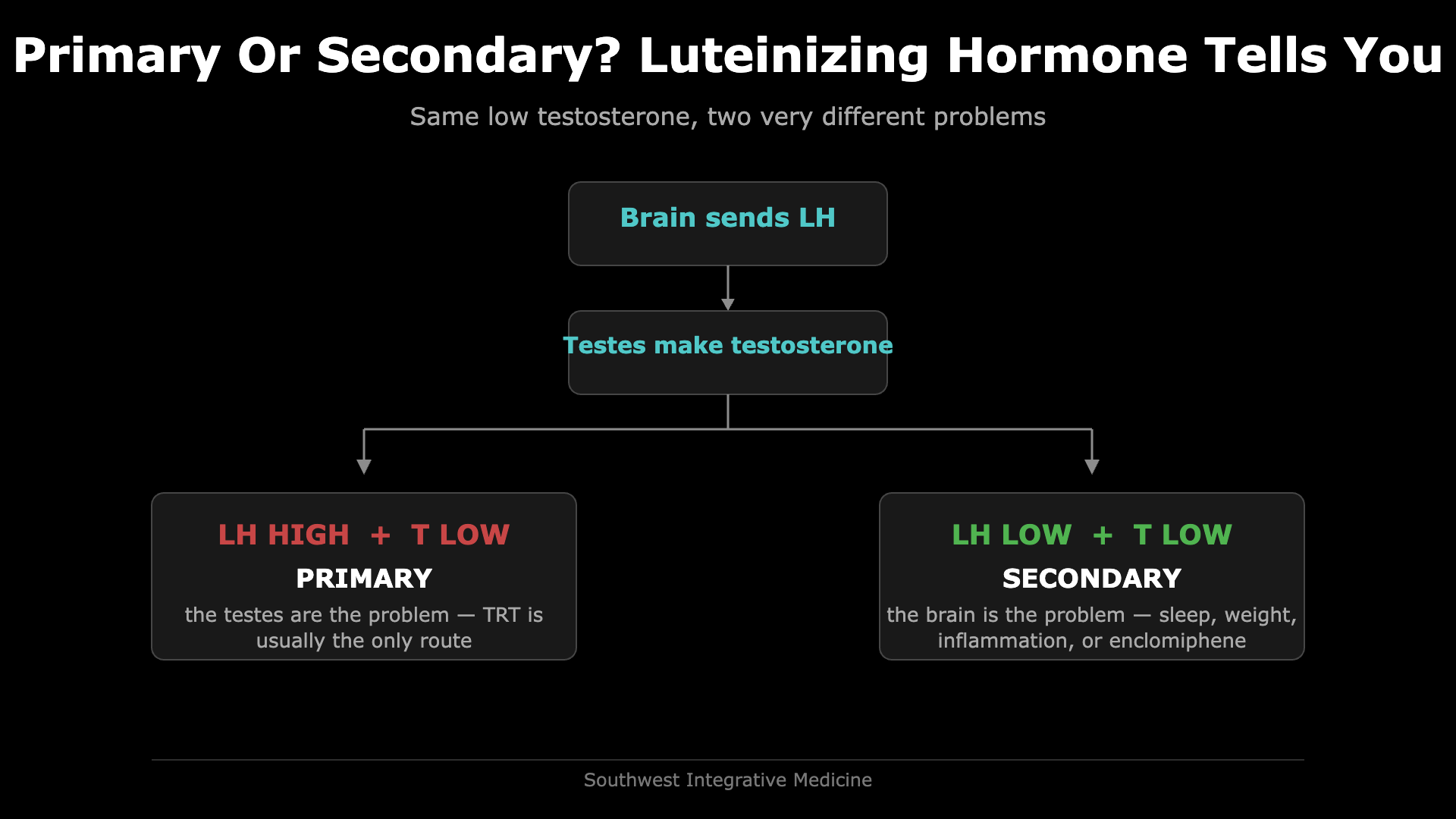
Primary low testosterone, or primary hypogonadism, occurs when the testes themselves fail to make adequate amounts of testosterone. This can happen for various reasons, but the Leydig cells in the testes are not performing the way that they should.
This can happen from some kind of damage to those Leydig cells. Hereditary hemochromatosis can cause damage to the Leydig cells. There could be some other birth defects going on there with the Leydig cells. And then sometimes, over time, it's common for those Leydig cells to start to decrease their responsiveness to the luteinizing hormone coming from the brain — so there's plenty of stimulus there, but they're just no longer responding. This is common as we get older.
There are also things like Klinefelter syndrome, physical injury to the testes, some kind of blunt force trauma, or chemotherapy and radiation, which can also damage the Leydig cells and the testicular tissue, leading to that lack of responsiveness.
This type of hypogonadism is common when you get to older age for males — when you're 50 plus, I would say. And 50 isn't necessarily that old, but the older you get, the more likely you're going to have the primary type. That being said, I do have many men in their 60s that have more of a secondary picture.
How The Labs Tell Them Apart
When we're identifying whether or not you have primary or secondary, it really comes down to the amount of testosterone that you're producing and the amount of luteinizing hormone.
In primary cases, typically you're going to have a low testosterone as defined previously — 400 to 450 nanograms per deciliter or less — and you're also going to have a high or high-normal luteinizing hormone.
You may have one test result that shows elevated luteinizing hormone and low testosterone, but you want to do this on multiple occasions. That's going to give you the clearest idea of what's going on, because sometimes you can have a spike in the luteinizing hormone for various reasons and then next time you check it, it goes down. But with a consistently elevated luteinizing hormone in the presence of low testosterone, you can be assured that you have more of a primary hypogonadism going on.
Treatment Options In Primary Low T
In this case treatment options are going to be limited more to testosterone replacement therapy, meaning that the testes are basically putting out as much as they can and there's not a lot of other options in terms of getting your body to produce more testosterone.
Now in cases like hereditary hemochromatosis or some sort of damage to the testes, you may be able to recoup some of that if it's been short-lived and you remove the cause — in the case of hemochromatosis, remove that iron. If this has been going on for many, many years, chances are you're not going to be able to recoup the production of testosterone in the Leydig cells. So you're going to be looking at topical creams, injections, pills, or pellets for your testosterone replacement therapy.
In some cases you may be able to increase the amount of testosterone produced in the testes themselves by focusing on general lifestyle interventions like more exercise, lifting heavy weights, improving diet and things like that. But generally speaking, those types of things are going to work better in someone that has secondary hypogonadism.
Secondary Hypogonadism: The Problem Is In The Brain
Secondary hypogonadism is basically the opposite of primary. The problem originates not in the testes but in the brain itself — specifically the hypothalamus or pituitary gland is failing to produce the appropriate stimulus or hormones to the testes. So you may not be getting enough gonadotropin-releasing hormone from the hypothalamus, or you may not be getting enough luteinizing hormone from the pituitary. These signals are needed in order to stimulate the testes to make testosterone.
So what could be causing that? Common causes of the brain not producing enough of these hormones have to do with stress — both physical stress and psychological stress.
When you have physical stress, it's going to be things like inflammation. Anything that drives more of an inflammatory process in our bodies could potentially lead to some interference with the signaling in the brain, in the hypothalamus and the pituitary. And then cortisol itself. Poor sleep, in and of itself and independent of high cortisol, can also reduce the amount of luteinizing hormone that's being produced, which normally is produced at night. So sleep is one of the big factors to focus on there.
In the category of inflammation, things that can increase it would be metabolic syndrome, obesity, toxins like endocrine-disrupting chemicals, and alcohol. Certain medications can also interfere with the regulation of hormones at the pituitary gland — these would include opiate-type medications, and also a lot of mood stabilizers, which will reduce the luteinizing hormone output. I should also mention that pituitary tumors like a prolactinoma would also likely cause some reduction of luteinizing hormone, and therefore low testosterone symptoms.
The symptom onset for secondary hypogonadism really can happen at any age, and I would say the vast majority of younger males with low testosterone are dealing with a secondary source.
What Secondary Labs Look Like
The lab results for secondary hypogonadism are going to look similar in terms of the testosterone to primary. The main difference is going to be that luteinizing hormone in this case is going to be low. You may also have higher prolactin, which in that case would be suggestive of a pituitary tumor called a prolactinoma.
Treating Secondary Low Testosterone
Treatment in this case could definitely focus on removing any lifestyle factors that may be influencing the hypothalamic-pituitary-testicular axis. Things like metabolic syndrome and obesity are strongly associated with secondary hypogonadism, and it's likely due to the effect of excess body fat on hormonal regulation. That's why a lot of times when we're doing more exercise, eating right and things like that, we do see a steady increase in the testosterone level. Focusing on exercise is going to give you better sleep as well, which also helps reduce stress levels.
Of course the lifestyle measures are always good to introduce, but they sometimes take a lot longer and give lackluster results. There are other medical interventions that you can use if you're finding yourself in the secondary hypogonadism scenario — that would be things like clomiphene or enclomiphene.
Both of these medications work by tricking the brain into thinking that there's not enough estrogen being produced by the body. Estrogen comes from testosterone, so it's really a signal that your body is getting testosterone or not getting testosterone. Clomiphene and enclomiphene block the brain's perception of this, and with that the brain starts to produce more luteinizing hormone because it thinks it's not getting enough. When you do that, the testes get stimulated and testosterone levels go up.
Now these medications are definitely not approved for low testosterone. They're mainly used for fertility, and enclomiphene has not even been approved here in the US for anything according to the FDA, but it is still used here quite often. Enclomiphene seems to have a more direct, more specific effect on improving the luteinizing hormone, versus clomiphene which has a more general effect on blocking the estrogen receptors.
When you introduce either one of these, you're also going to get an increased production of follicle-stimulating hormone, and both the increase in FSH and luteinizing hormone are going to give you improved fertility as well.
Using one of these treatment options is also going to allow you to have much more control over starting and stopping, because your levels aren't going to go down as much when you're on these products. So if you want to go on for a short period of time, it's going to be a little bit easier transition when you stop those meds, versus if you're on testosterone replacement therapy. Even though the medications are synthetic, it's a somewhat more natural way, because you're encouraging your body to do the work.
Especially For Younger Men
As I mentioned earlier, with secondary hypogonadism it's important to try to find out what the cause might be and to intervene with sleep and lifestyle modifications, because I've seen in my practice where levels can definitely come up just from taking those steps — eating better, fewer carbs, maybe losing 5 to 10 pounds depending on where you're at, and also lifting heavier weights to encourage your body to make more testosterone. This is going to be a much more sustainable way to get your body moving in the right direction.
But it's not the right move for everyone, which is why I wanted to lay out some of the other options here. Especially for younger men who are looking at their testosterone, feeling tired, and thinking they might need to be on testosterone — these other options are going to be much safer and much better for you than going on testosterone replacement therapy. The lifestyle factors are much encouraged, because you still have the rest of your life ahead of you. And if you've really given these a good effort and you're still not getting the results that you expect, we always have these other options to fall back on.
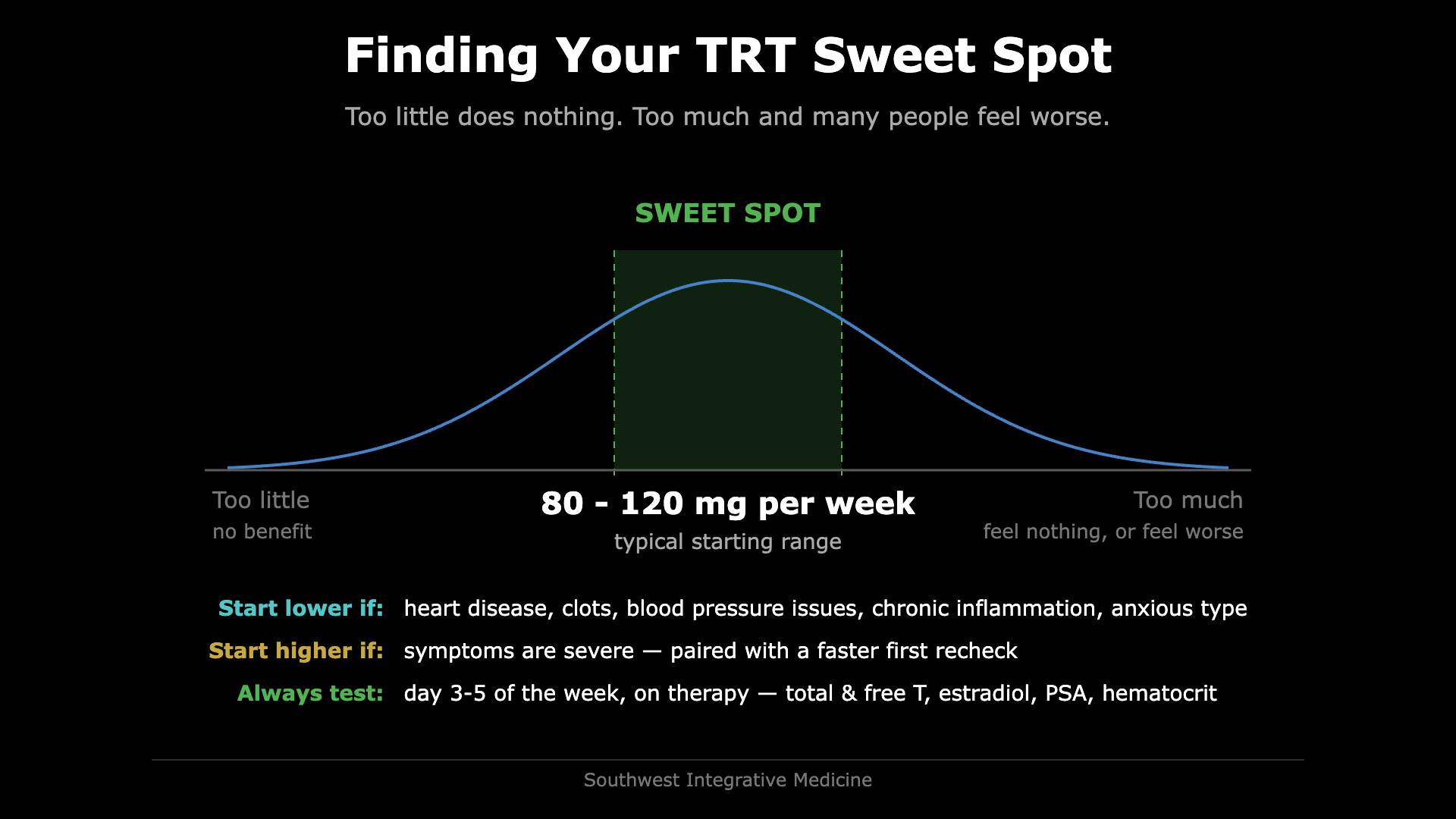
If you do end up on replacement therapy, the starting dose matters a great deal, and it's worth knowing what testosterone does to your PSA before you begin.
Not sure whether your numbers point to primary or secondary? Run them through the TRT Lab Analyzer, or schedule an appointment and we can work through it together.