







So you started TRT and you felt amazing — like a new man. Energy up, mood improving, everything clicking along. But then, weeks or months down the road, bam: suddenly you're anxious, you're having heart palpitations, you can't sleep, energy is going down, everything seems to be getting worse. What happened to the magic TRT?
This TRT honeymoon turning sour is a common scenario and a common puzzle I help my patients figure out. It's often a sign that your dose — while initially okay or even perfect — has become too much for your system. Today we'll walk through the steps to figure out if your testosterone is too high, why these signs get overlooked, and the real source of these confusing symptoms.
Step One: Connect Your Symptoms To The Timeline
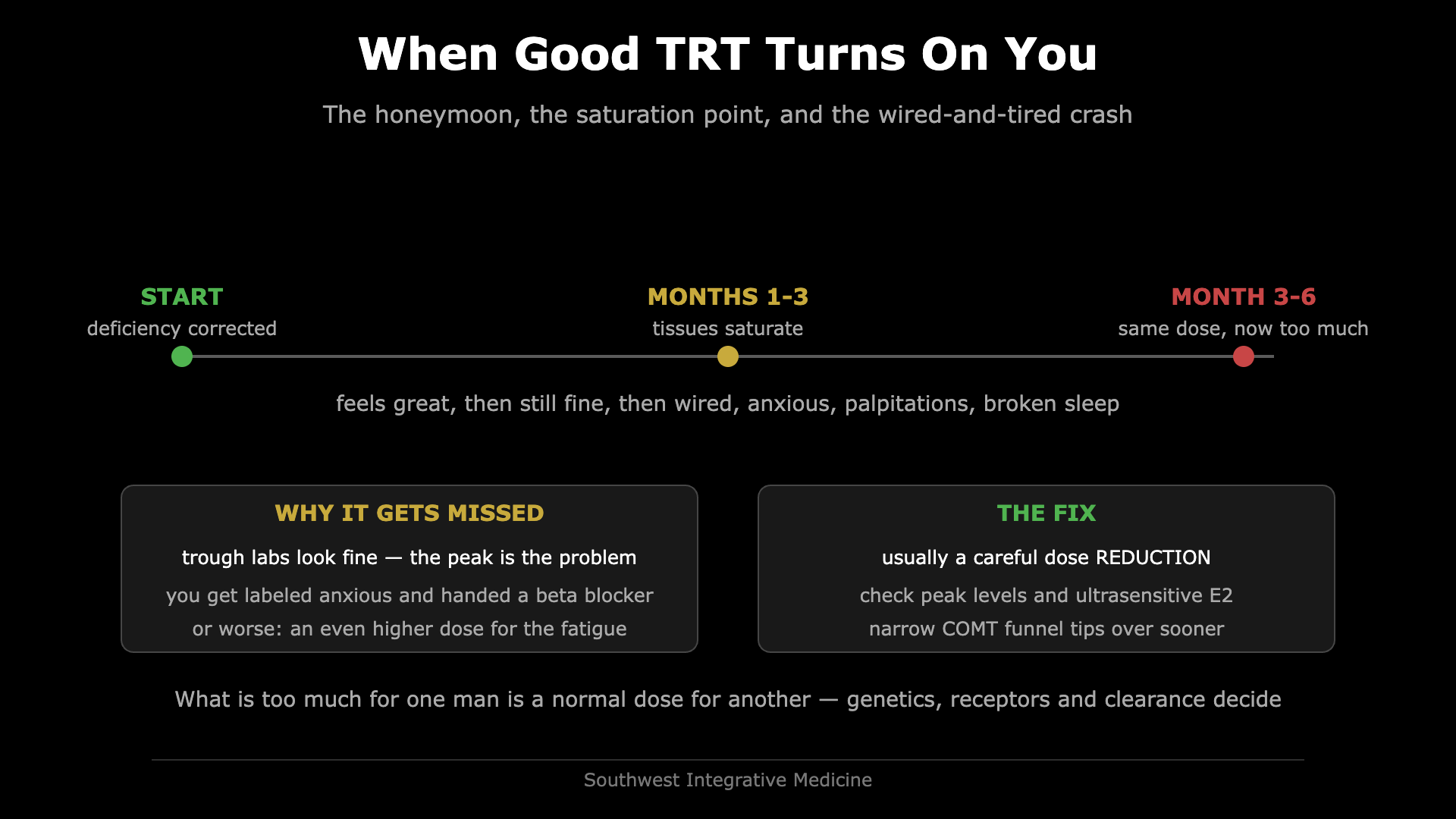
The switch from TRT feeling awesome to suddenly feeling wired, anxious, palpitating and sleepless usually isn't random. It typically happens somewhere between one month and six months in — usually around the three-month mark.
Why? Your body initially benefits as you correct the deficiency. But over time your tissues become more and more saturated with testosterone, and the same dose that was precisely right at the start becomes an overload. This delayed onset is exactly why it's so confusing to connect the dots: you felt so good on this dose, and you're still on the same dose, so it can't be the TRT, right? Definitively wrong. The timeline is the first big clue.
Step Two: Recognize Adrenergic Overstimulation
This is where many guys get misdiagnosed. The most commonly overlooked sign of too much testosterone — especially with the delayed onset — is adrenergic overstimulation.
We have two systems working on the central nervous system: fight-or-flight (adrenergic, sympathetic) and rest-and-digest (parasympathetic). Testosterone supports the fight-or-flight side. Revving it up initially feels good when you're tired and run down — but depending on how your system is wired, your receptor density, and how fast your body breaks down adrenergic signals, it can suddenly tip. What that feels like:
- New or worsening anxiety, constant edginess, inner restlessness, even a sense of doom or panic
- Heart palpitations or a racing heart when you should be calm — sometimes waking you in the middle of the night
- Sleep disturbance and frequent waking — so you're wired but also tired
- Energy that initially felt great now trending down, because the excess stimulation is wrecking your sleep
Mechanistically, testosterone influences the adrenergic receptors — the docking sites for norepinephrine and dopamine. In a normal, deficiency-correcting range it often lowers cortisol. But on adrenergic overload you create a chronic stress physiology, and the threshold for tipping from even-keeled into anxious gets much thinner. Studies show supraphysiologic androgen levels can impact these anxiety pathways — and what's supraphysiologic for one person is not supraphysiologic for the next.
This is also why it gets missed: the timeline is delayed, the dose "isn't that high," and you get labeled anxious, stressed, or insomniac. You're handed a beta blocker or anxiety meds — or worse, since you're now fatigued from not sleeping, a higher testosterone dose. Then you're in a vicious cycle.
Step Three: Check The Peak, Not Just The Trough
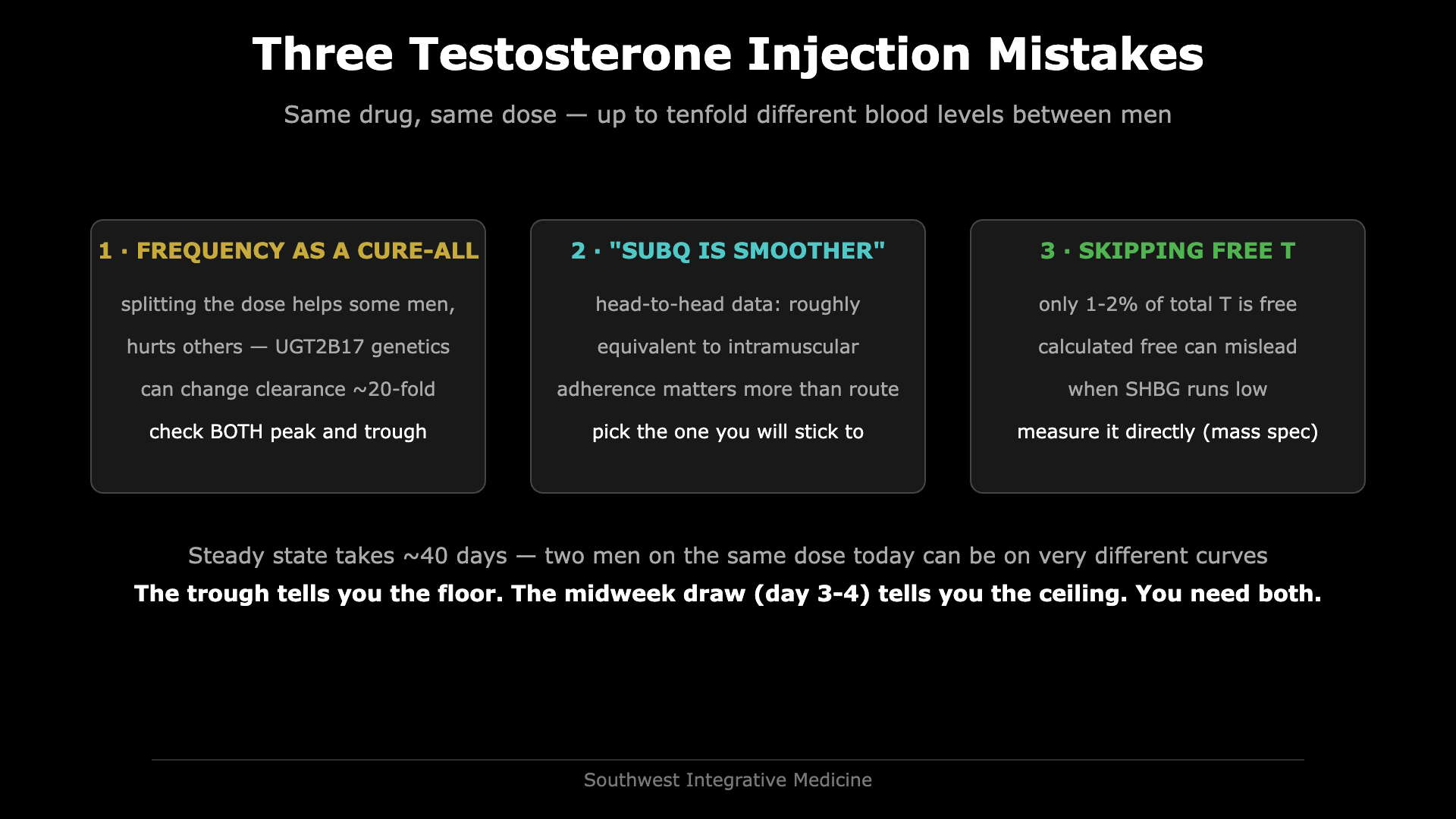
Most TRT monitoring uses trough levels — your lowest point right before the next dose. The trough is useful to make sure you're not deficient. But if you're having overstimulation effects, your trough can look fine or even low on paper while the peak is where the symptoms are coming from. Connect when your symptoms come on to when you inject, and check your levels at the peak — not just the trough.
Step Four: Rule Out The Estradiol Wave
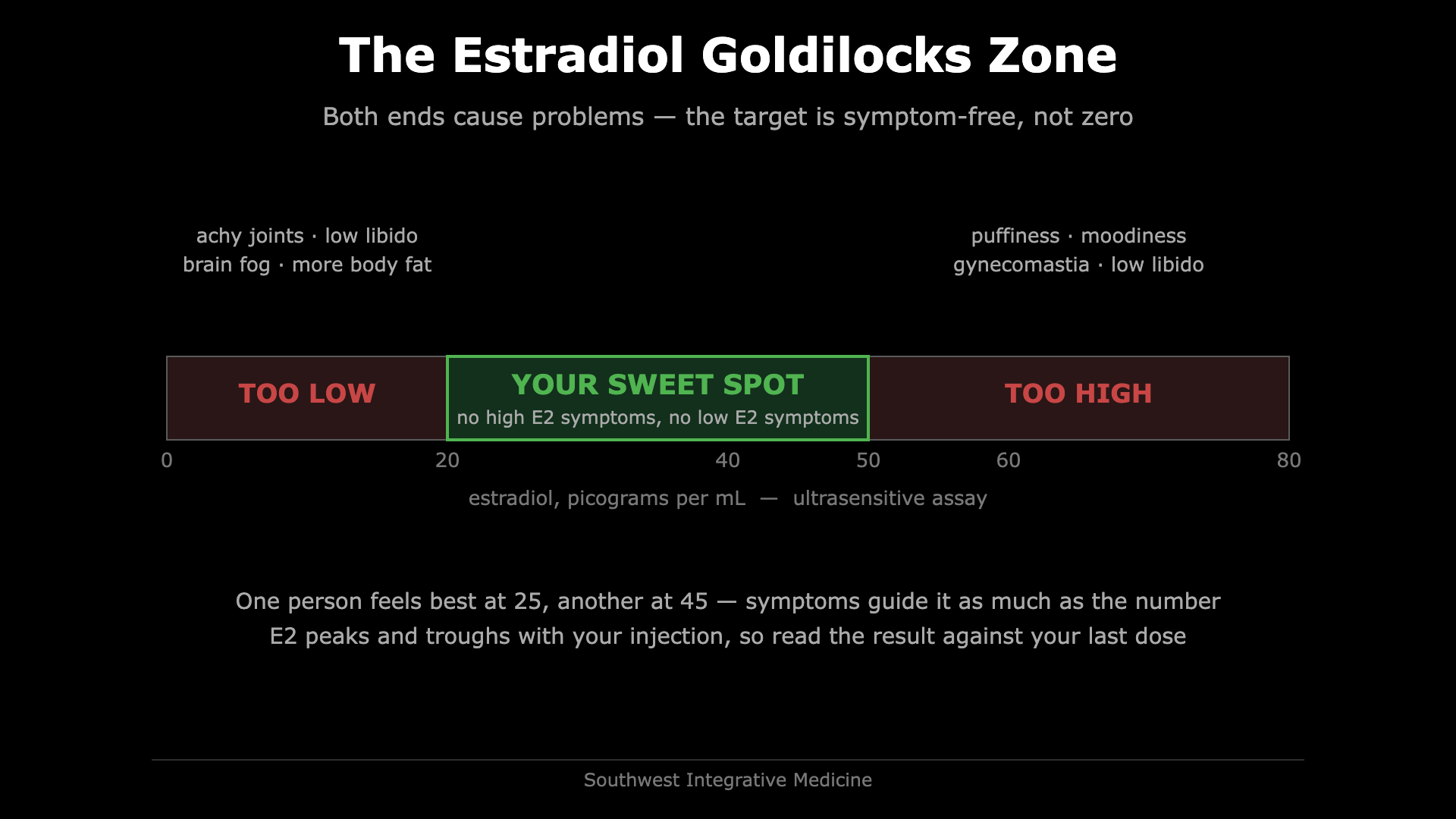
It's not always the testosterone itself. When testosterone runs high, more of it converts to estradiol through aromatization, creating a secondary wave of symptoms: water retention, puffiness, nipple sensitivity or swelling, emotional ups and downs, libido issues. Check estradiol with the most accurate (ultrasensitive) test, at the peak. Typically when testosterone is really high, E2 is high too — but some people run high E2 even at normal testosterone, so distinguish the two. I went deeper on this in TRT and high estrogen.
Step Five: Respect Your Unique Genetics And Sensitivity
This is where people get into trouble comparing their dose to other people's dose. There is no one-size-fits-all level. A dose that makes one man feel superhuman for years can make another wired, anxious and sleepless. Age and overall health play in — and so does how efficiently your body clears adrenergic substances like dopamine, norepinephrine and epinephrine.
One of those clearance enzymes is COMT, which helps eliminate both estrogen and dopamine. If you have a genetic alteration in COMT, your funnel is narrower. Testosterone raises estrogen; estrogen, dopamine and norepinephrine all go through that same funnel. Stack more into a narrow funnel and it overflows — those stimulating molecules circulate, find their receptors, and rev the system. Add higher receptor density and you need even less to feel overstimulated. That's much of the variability between the man who feels great at a total of 1,000 and the man who feels great at 500 or 600.
Step Six: The Fix Is Usually Less, Not More
If the timeline fits and the symptoms fit, the solution isn't adding medications to chase symptoms. It's strategically and carefully considering a dose reduction with your doctor — finding the sweet spot where you keep the benefits without the overload. If your TRT felt great and then turned into anxiety, palpitations and bad sleep around one to six months in, that's often delayed adrenergic overstimulation from a dose that's now simply too high for your system — and it's frequently overlooked.
Worth reading next: the best starting dose for TRT and the injection mistakes that push peaks too high.
Want to see whether your numbers and symptoms point to too much testosterone? Run them through the TRT Lab Analyzer, or schedule an appointment.