







"I was fine on 150 mg every 2 weeks and then I hit a wall on day 11." "180 milligrams twice a week and my total blew past 1500 — now I'm anxious and I can't sleep 24 hours after my shot." "100 milligrams a week, 3 months in, and my total is only at 233."
Any of this sound familiar? I hear these and similar things every day. These are three real men, same drug, three completely different outcomes. This isn't bad luck. There are specific enzymes deciding how each of these men handles their testosterone, and the variation between them is measurable and published in the literature — yet it's almost never named in TRT content.
This article is about the three mistakes I see driving these kinds of problems, and what to do instead. I work with men on TRT every single day, and the pattern keeps repeating: guys follow the standard advice, they don't feel right, and their doctor tells them everything looks fine. The missing piece is the individual variation in how the body actually processes testosterone, plus labs that aren't given proper context.
Why The Same Dose Behaves So Differently
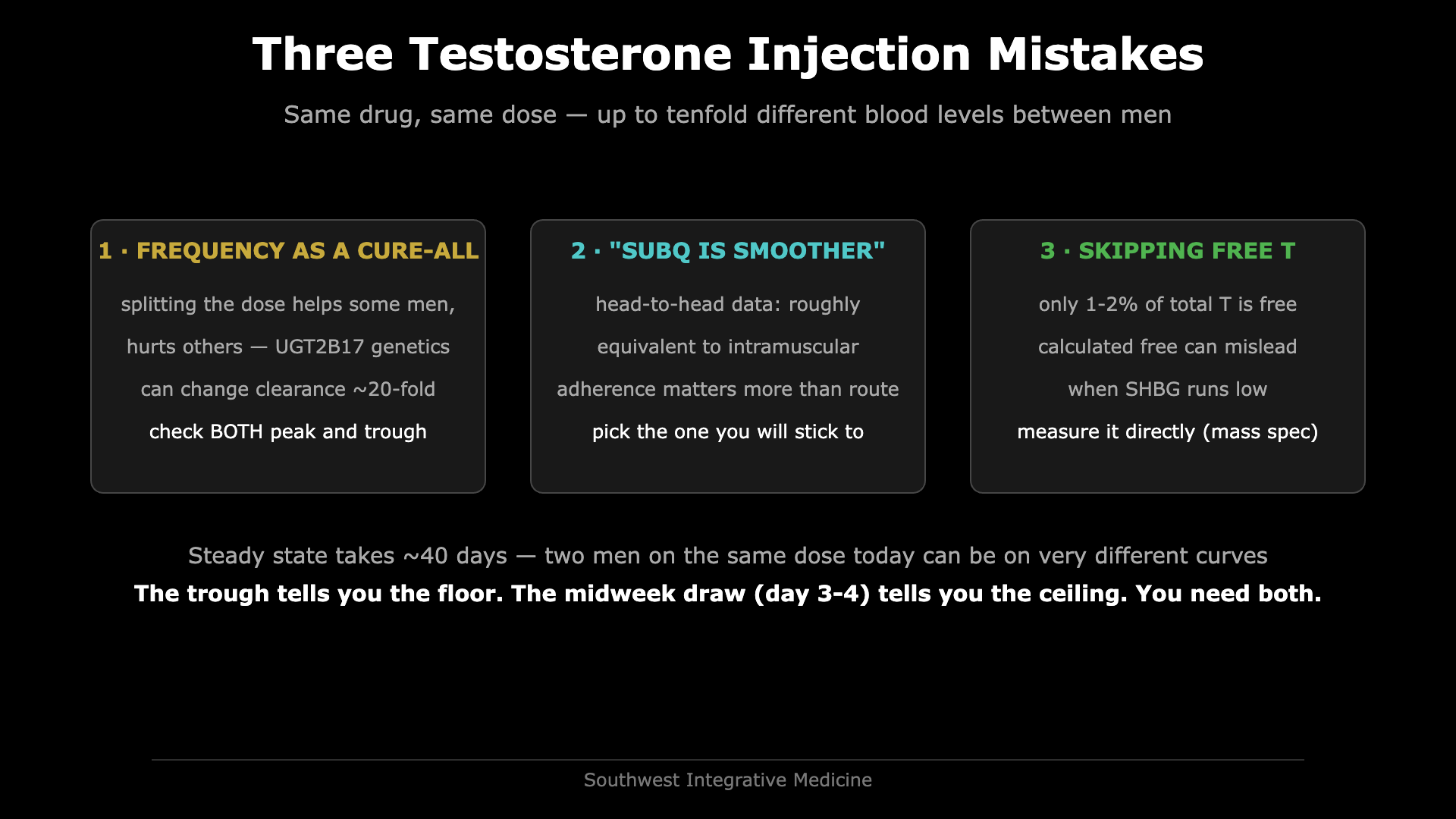
Two men on the exact same dose and schedule can have blood tests four days later that look completely different — not slightly. Ekström and colleagues in 2013 found that hypogonadal men on the exact same testosterone enanthate dose had serum peaks that ranged roughly tenfold across patients. Same drug, same dose, same protocol.
Genetics explain part of this. Body composition, liver clearance, sex hormone binding globulin and other protein binding also make up a portion, and so does your dose history. Which gets at the point: there's no universal TRT protocol. There's only the protocol that fits you.
Mistake 1: Treating Frequency As A Universal Fix
The standard online advice is to split the dose — twice weekly, three times a week, even every other day — for smoother levels and fewer side effects. For some men, yes, that makes sense. For others, once a week is actually fine, and in some cases splitting the dose can make things worse.
The reason comes down to two things: your enzymes and your dose history.
The enzymes. Glucuronidation is one of the main inactivation pathways for testosterone — the way your body reduces the amount of testosterone circulating. The UGT2B17 enzyme is the predominant player, and it has a common deletion polymorphism. Studies found that after a single 300 mg dose of testosterone, men with the intact gene cleared roughly 20 times the amount of testosterone as someone with the full deletion. Same dose, totally different serum levels over time. This isn't obscure: about 9% of European men have the deletion, and roughly two-thirds of men in East Asia. Other pathways — DHT genetics, the aromatase enzyme, sulfation (the backup when glucuronidation isn't working) — have similar variants. Stack a few together and you get that tenfold difference.
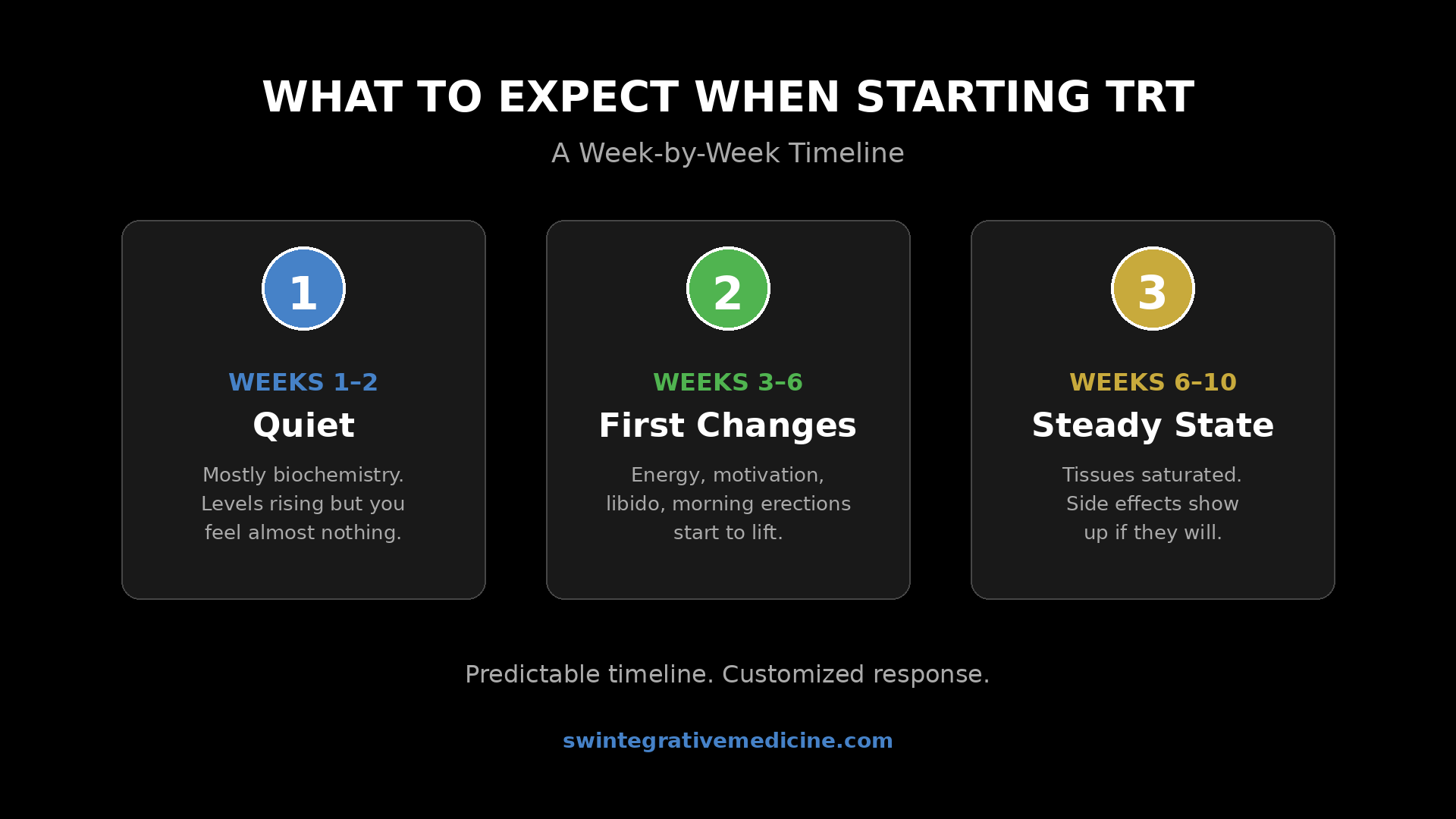
Dose history. Testosterone cypionate has a half-life around eight days, and steady state takes roughly five half-lives — about 40 days. Two men on 120 mg a week today are not at the same point on that curve. One has been on 80 mg for six months and just bumped up — he's climbing toward a new higher steady state. The other came down from 200 and is descending. At day five their numbers can differ drastically, even on the same dose this week. Most online advice treats every dose as if the patient started yesterday. The body doesn't treat it that way.
The trough-only trap. The standard advice is to check trough levels and adjust off the trough. The trough by itself is half the picture. Say a patient pulls a trough at day seven and it's 380 — the reflex is to increase the dose. But the peak early in the week could have been 1,400. Bumping the dose pushes that peak even higher, driving estradiol, hematocrit, and the anxiety or palpitations. You need both: a true trough right before your next injection, and a midweek draw around day three or four to capture the peak. The trough tells you the floor; the midweek tells you the ceiling.
Mistake 2: Believing Subcutaneous Is Automatically Smoother
The claim is that subcutaneous testosterone produces dramatically smoother pharmacokinetics than the intramuscular "roller coaster." I went back to the head-to-head research, and the picture is more honest than the standard advice.
Wilson and colleagues (2008) compared subQ directly against IM: subQ was well tolerated and delivered equivalent testosterone levels, but they flagged wide intra- and inter-patient variability — the same genetic and dose-history variability discussed above shows up regardless of route. A retrospective study in the Journal of Clinical Endocrinology & Metabolism found subcutaneous cypionate and enanthate effective, safe, and preferred by patients for convenience. Another found testosterone stayed stable between subQ injections.
The study most often cited as proof subQ is better used a specific auto-injector device — testosterone enanthate in castor oil with a 27-gauge needle — and it did produce lower hematocrit and lower estradiol than IM at 12 weeks. If that reproduces with a manual subQ injection, a slightly different ester and carrier oil, you'd expect roughly the same. But it might not — it's a different ester, different oil, different delivery system.
The bigger practical thing I stress to my patients: how does it fit your life? If you can't reliably dose more than once a week, you'll be chasing your tail — frequency and adherence matter more than the route. If you pick subQ for the smoother curve and then only inject once a week anyway, you're not getting a smoother curve, you're getting a worse one. In my experience subQ performs about equivalent to IM on the pharmacokinetics, hematocrit, and estrogen. The "much smoother" claim is overstated relative to the head-to-head data. There's nothing wrong with trying it — just confirm with labs, not just how you feel.
Mistake 3: Skipping Your Actual Free Testosterone
This one ruins dose decisions more than the first two. I see people at TRT clinics where free testosterone isn't even ordered. The total T comes back, the doctor says it looks optimized, and the dosing decision gets put off despite the person not feeling good — nobody pulled the number that tells you what's happening at the receptor.
Testosterone in your blood is mostly bound to carrier proteins — some bind tightly, some loosely like albumin. Roughly 1 to 2% of your total is truly free and available to bind the receptor. The units get tricky: total T is reported in ng/dL, free T in pg/mL. If your total is 600 ng/dL, that's 6,000 pg/mL — and 1 to 2% of that is 60 to 120 pg/mL, within the normal free range. That 1–2% isn't a guess; it's validated with mass-spec and liquid chromatography studies going back to the 1960s.
Free testosterone is what crosses into your tissues and gets used. Total T is bound and essentially inert until released. Two men can sit at the same total and have completely different free levels. Patient A: total 700, free high at 140 at trough — anxious, irritable, sleep disturbed, hematocrit climbing. The move is a dose decrease or frequency change, not an increase. Patient B: same total 700, free low at 70 — still tired with low libido. The answer isn't chasing the total; it's working out why his free is low.
And how you measure matters. Most labs report a calculated free testosterone from the Vermeulen equation. Calculated free is fine for trending when nothing is unusual, but it can be falsely reassuring — when SHBG is low or low-normal, the equation assumes more free testosterone than you actually have, and the number looks okay while the patient stays symptomatic. Run the equilibrium dialysis / mass-spec version that measures free testosterone directly. No formula, no assumption. That's what catches the falsely-okay calculated results.
And layering back to mistake one: the man with the glucuronidation deletion clears testosterone slowly, so his free T can run higher than his total predicts. A man with high aromatase activity converts more to estradiol, and his free T moves down. Enzyme variability shows up in those calculators too.
The Takeaway
Your dose, your frequency, and your route should be calibrated to your enzymes, your dose history, and your directly-measured free testosterone — not to a forum consensus or someone else's protocol. Start with both numbers, peak and trough, and read them against your symptoms.
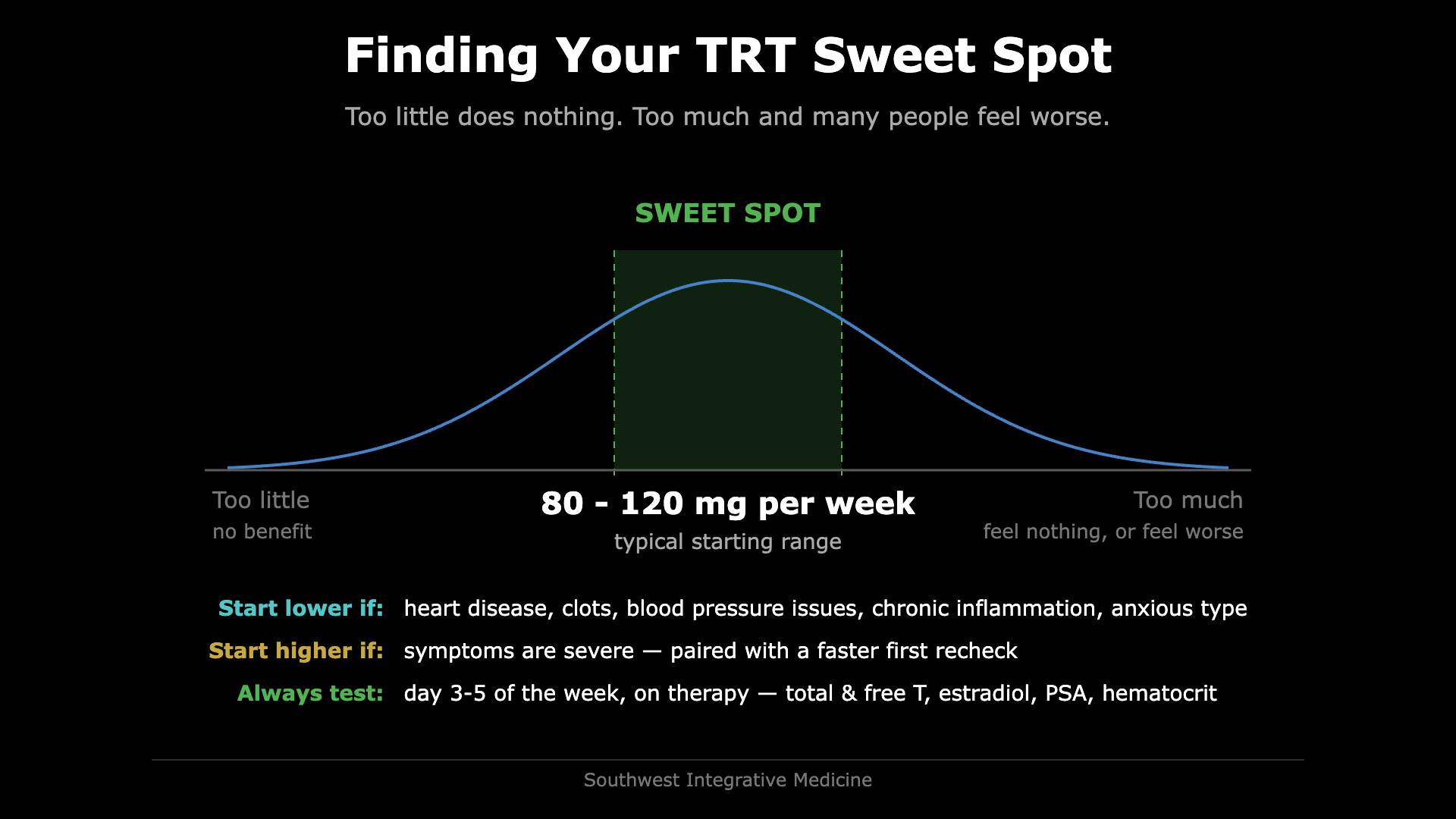
If you're still dialing things in, start with the best starting dose for TRT, and know what your estradiol should look like along the way.
Want your numbers read in context? Run them through the TRT Lab Analyzer, or schedule an appointment.