







If you're thinking about starting testosterone replacement therapy, you probably want to know what's actually going to happen — week by week — once that first injection is in. The reality is that TRT follows a fairly predictable timeline for most people, but the timing and intensity of changes will vary. This guide breaks down what to expect through about week 10, when you'll feel changes, the side effects to watch for, and when it makes sense to get labs checked.
Quick disclaimer: this is general guidance, not a personalized protocol. If you want a customized answer for your situation, working directly with a clinician is the way to do that.
Understanding the Basics: What Form Of Testosterone You're Using
The framework below applies most reliably to injectable testosterone replacement therapy — testosterone cypionate is the most common, but enanthate and other esters generally behave the same way. Topical and cream forms follow a similar pattern in principle, but they're less reliable because absorption through the skin can vary. Some patients on creams don't notice the changes I'm about to describe, and the most common reason is that the cream simply isn't absorbing well.
If you're not noticing the expected changes on a topical, the issue could be poor absorption, a dose that's too low, or estrogen running too high — and the only way to know which is to test.
The First Two Weeks: Don't Expect To Feel Much
The first one to two weeks of TRT is mostly biochemistry. Your blood levels haven't reached steady state yet, and the body is adjusting to exogenous testosterone. For the average person, you're not really going to notice much at all. Some men feel a mild early lift in energy or mood. Others feel nothing until week three or beyond. Both are normal.
This is also why I tell patients not to judge the protocol off the first injection. One dose generally doesn't move the needle, and any strong reaction in the first few days — for or against — is more likely to reflect something other than the testosterone itself.
Weeks Three To Six: Where Most Patients Notice The Change
Week three to four is typically when you start to notice an actual day-to-day improvement. The most reliable change is in energy and motivation. People describe it as not being as exhausted by the end of the day. Instead of going home and falling asleep on the couch, they have the bandwidth to work on a project around the house, or do something they'd normally put off because they were too tired.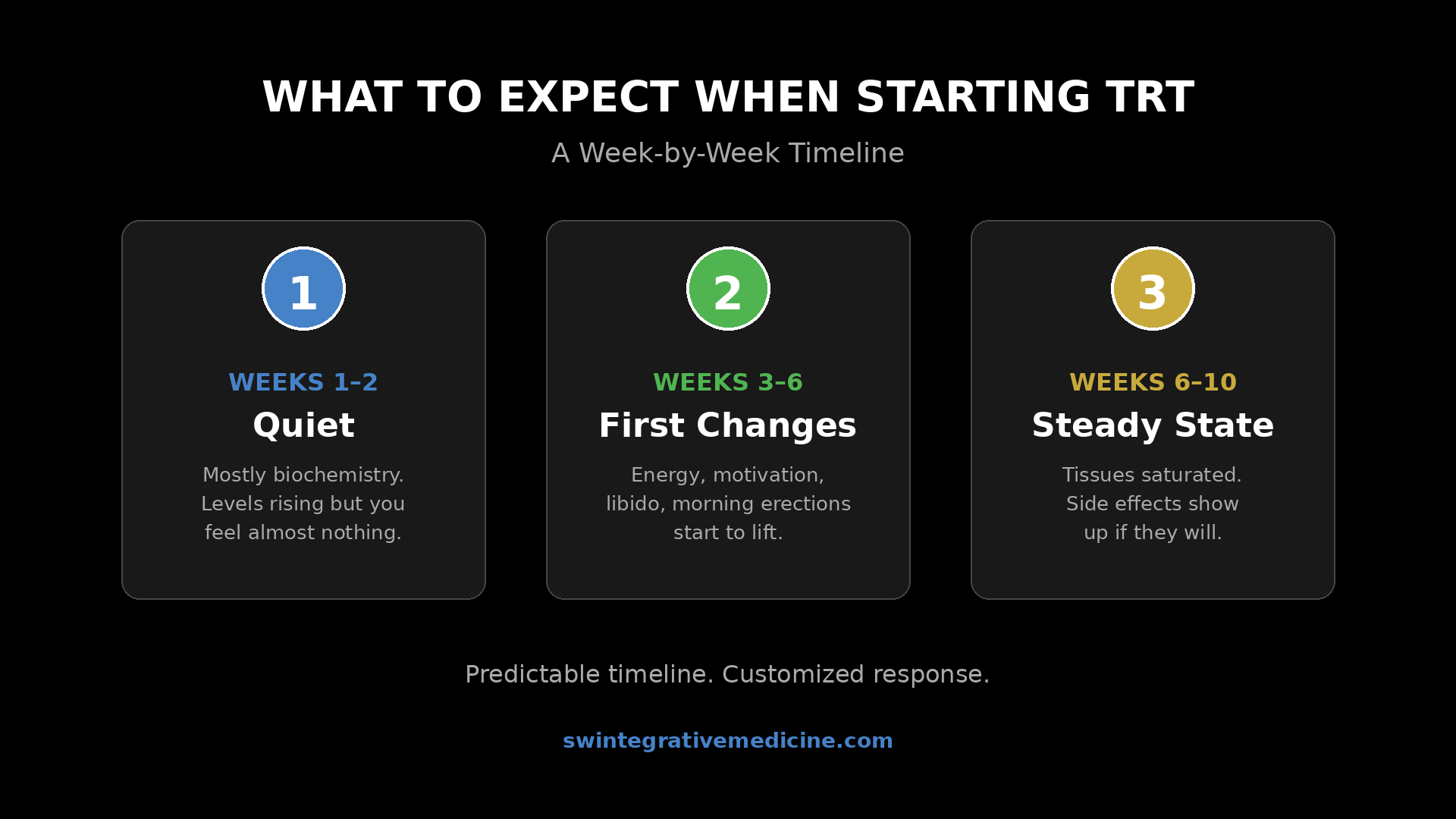
This isn't usually a "turn into a superhuman" moment. Some patients walk in expecting a dramatic transformation and feel let down when what they get is a steadier, more usable kind of energy. That steadier energy is the win, and it builds.
Around week three to four you may also notice the early signs of improved libido and erectile function — more morning erections, more interest, easier function. By weeks five and six, those changes turn up further: more motivation, more libido, more reliable erectile function. If you didn't notice anything in weeks three or four, the things I just described will often show up here instead.
By the end of weeks 8 to 10, your body is about as saturated as it's going to get on your current dose. The tissues have absorbed what they can absorb, and you've reached a new steady state — provided you're injecting consistently on a regular schedule. If you skip doses or run irregular timing, you'll get more mixed and less predictable results.
Navigating Side Effects And Their Timing
Side effects on TRT have their own timeline, and most are not the things people worry about most. Here's how to think about it:
Reactions after one or two shots. I do see patients who report symptoms after their first or second injection. In most of these cases I don't think it's actually the testosterone causing the problem — one dose barely raises your levels, and most people don't even feel the testosterone yet at that point. What's more likely is a reaction to the carrier oil in the injection itself (sesame, cottonseed, or grapeseed depending on the formulation), which can produce something that looks like an allergic response. Switching the carrier or changing form often resolves it.
Classic side effects (estradiol, hematocrit) — covered separately. The "classic" adverse effects of TRT are things like rising estrogen, rising red blood cell count, and the symptoms that come with each. Those have their own timeline and warrant their own discussion. The video and post you're reading focus on a different category.
Stimulation-type side effects. The under-discussed category is what I'd call overstimulation symptoms: anxiety, elevated heart rate, elevated blood pressure, trouble staying asleep, sometimes irritability or anger. These can show up anywhere from four weeks to four months after starting TRT, often as your dose climbs or as you approach saturation.
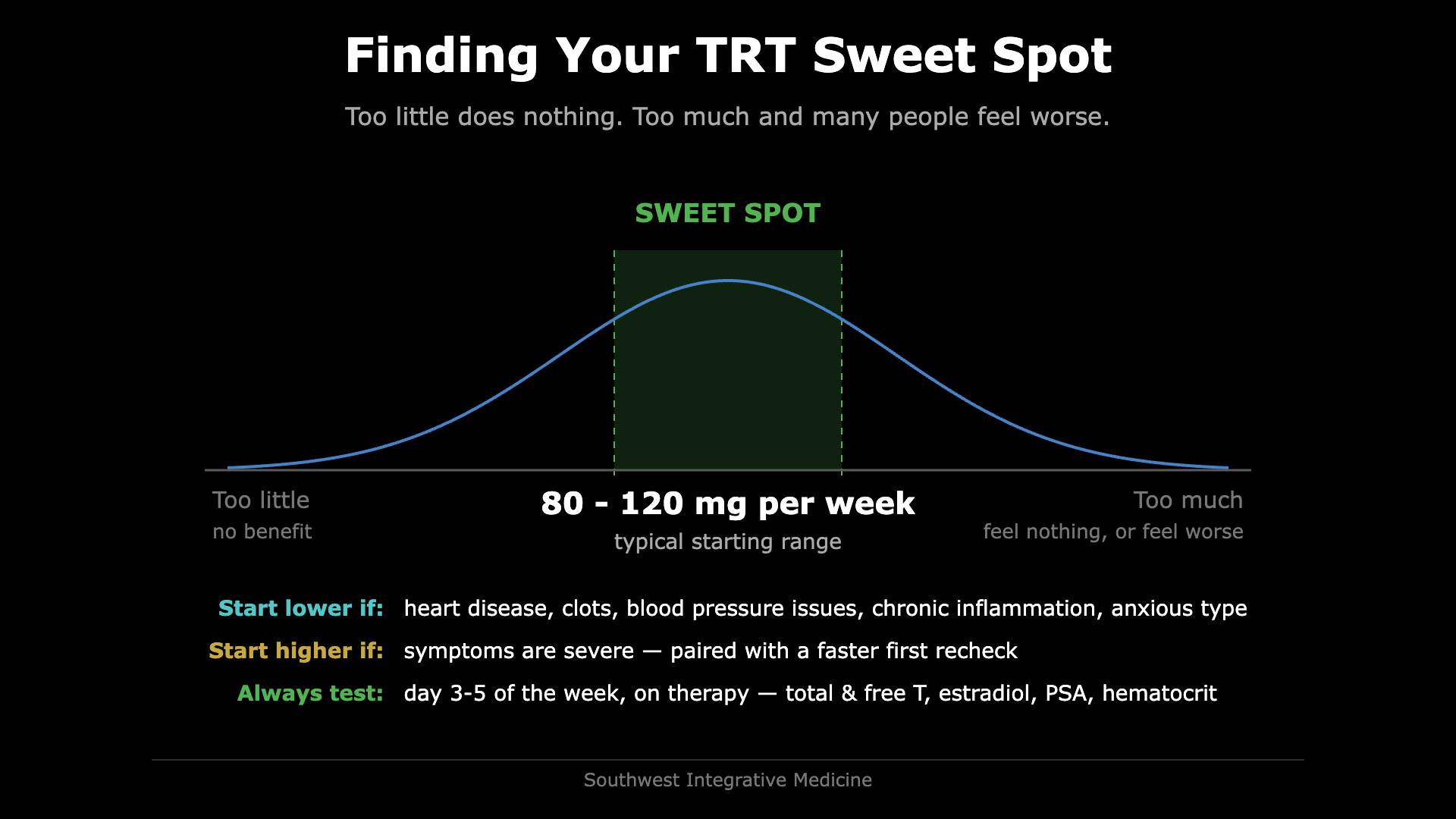
The reason isn't fully understood, but here's a useful way to think about it. Low doses of testosterone tend to stabilize the mood and the nervous system. Higher doses can be stimulating — sometimes too stimulating. What's "low" for one person may be too much for another. It's a bell curve, similar to the way dopamine works for focus: too little is bad, too much is also bad, and the sweet spot is in the middle.
I've watched the most anxious patients get a profoundly calming effect from a moderate dose of testosterone, and I've watched seemingly calm patients become wired and stimulated on a relatively low dose. Both groups started with classic low-T labs and low-T symptoms. Same diagnosis, very different responses.
Customizing Your Dose: Feel + Labs
This is why dose has to be customized. Two inputs matter: how you feel, and what your labs show. Either one alone is misleading. Lab values that look "in range" on paper can still be off for you specifically, and a great subjective response can mask a hematocrit or estradiol that's quietly drifting in the wrong direction.
The right time to check labs the first time is roughly 6 to 8 weeks in, drawn at trough (right before your next dose). That gives you the lowest point of your cycle and a real read on whether the protocol is working. After that, recheck a few weeks after any dose change, and at regular intervals thereafter to monitor hematocrit and estradiol over the long run.
If you're early in your TRT and not sure whether what you're feeling is on track or off, the answer is almost always to combine your felt experience with what the labs are showing — and adjust from there. The protocol that works best is the one customized to you, not the one that worked for a friend or that you read about on a forum.
Final Thoughts
Most of TRT's predictable timeline plays out in the first 10 weeks. The first two weeks are quiet. Weeks three to six are where energy, motivation, libido, and erectile function start to shift. Weeks six to ten bring you to steady state. Side effects, when they come, are often later than people expect, and the under-discussed category is stimulation — anxiety, irritability, sleep disruption — which often signals you've gone past your sweet spot rather than that TRT isn't right for you.
Don't judge the protocol too early, and don't push the dose higher just because more sounds better. Give it 6 to 8 weeks, retest at trough, and adjust from there.
If you want a personalized protocol with dose calculator and red-flag alerts, check out the TRT Optimization App. For the complete protocol, the Mastering Your TRT ebook walks through it step by step. Or work with me directly if you'd rather have a clinician guide the process.
Topics: TRT, Testosterone Replacement Therapy, Starting TRT, Low Testosterone, Hormone Therapy, Men's Health