




How To Lower Liver Enzymes Naturally
Are you wondering how to lower your liver enzymes in a more natural way? Maybe you've been dealing with ongoing elevations, or steadily going up liver enzymes, and you're worried about the long-term implications of this. In this video we're going to look at some basic ways to lower liver enzymes naturally. We'll also look at some supplements and herbs to lower liver enzymes naturally.
Finding The Cause Is The Most Important Thing
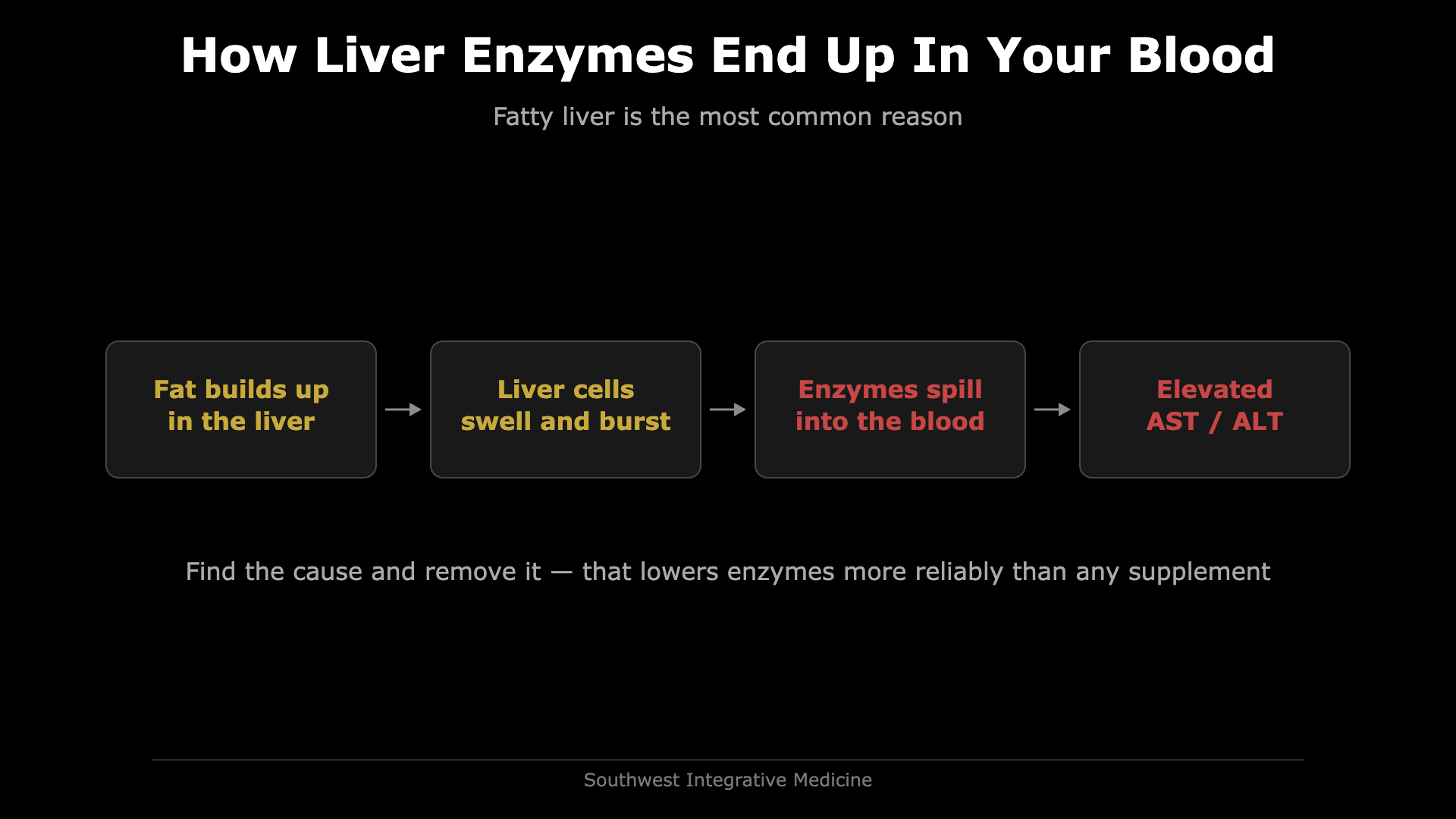
In looking at this question, it's of course important to point out finding the cause is the most important thing, and eliminating that cause directly is the most natural way and the best way to lower elevated liver enzymes. We will discuss some natural treatments that you can take on as well, but I first wanted to list the most common reasons why people have elevated liver enzymes, so you can correct those and look into those as well.
The Most Common Causes Of Elevated Liver Enzymes
One of the most common causes of elevated liver enzymes is non-alcoholic steatohepatitis, which is referred to as NASH, or non-alcoholic fatty liver disease. These are kind of the same mechanism process that's happening, where you have fatty infiltrates, or fatty accumulation, in your liver, which is causing those hepatocytes to burst open and spill into your blood. And then when you do your blood draw you see elevations in those liver enzymes. I did a separate video on that and how to look at that, so if you need more details on that definitely look at that video, something surrounding dietary influences of elevated liver enzymes.
The next most common influencer, of course, is alcohol. Some people are going to process alcohol differently, and there's some genetic things that are associated with how you process alcohol. And so one or two drinks a night may be causing your liver enzymes to go up, where someone else has one drink right before their test and that causes their liver enzymes to go up. Other people may be able to have three or four drinks per night and not have elevation in their liver enzymes. And I've literally seen these different variations in my practice. So how you process the alcohol is important. You can't say you can't have any alcohol because it's going to raise your liver enzymes. Of course alcohol isn't good for you, it is poisonous, it does affect the liver, but just some people have a harder time processing it than others.
The third thing that's kind of an easy thing to eliminate is if you are taking Tylenol on a regular basis, any kind of over-the-counter pain medication that could have Tylenol in it. Now the NSAIDs like ibuprofen, Aleve and aspirin don't typically elevate liver enzymes. They're going to have more effect on your stomach and kidneys. But Tylenol definitely does. So if you're taking any products with Tylenol in it, that might be one place to look as well.
Of course there's many other causes of elevated liver enzymes that you should always try to investigate before you're trying to lower your liver enzymes with a natural product or supplement. In other words, it's better to remove the cause of the elevated liver enzymes than take a supplement for the rest of your life just to keep your liver enzymes in a normal range. That being said, it is sometimes hard to find out what the actual cause is, and I usually recommend dietary changes first, as this is the most common reason why people do have elevated liver enzymes.
Exercise, And Making Sure They Actually Are Elevated
As I alluded to, there's also the influence of exercise. Not all exercise is going to do this. It has to be particularly difficult, strenuous exercise, intense exercise right before you do your blood test, and that can raise your liver enzymes as well. But if you're having ongoing elevated liver enzymes and you're not doing a strenuous exercise, you're kind of in a routine, that's not going to do it. But there's a separate video on that if you want to check that out as well.
I'll also mention quick here that it's also important to establish that they actually are elevated, right, after many many tests, before you go taking something to lower them. Maybe it was just a fluke. And the issue with exercise highlights that need to check multiple times before you go jumping to some conclusion that you have some sort of liver problem when maybe you actually don't.
Milk Thistle
All right, with all that preambling out of the way, let's look at how to lower liver enzymes naturally. The first option that I want to discuss, because I think it is very safe and very effective at protecting your liver and helping your liver process toxins and various substances, is milk thistle.
Milk thistle has been used for supporting liver and liver function for many, many years, and it's a very safe and effective herb. It does this by mainly protecting those liver cells and also increasing the amount of a substance called glutathione. Glutathione is one of the main things that our bodies use to detoxify. It also works as an antioxidant. So that's part of the protective capacity of milk thistle, because it's increasing glutathione. But milk thistle also has a separate protective antioxidant effect independent of what it does with glutathione as well.
Dandelion Root And Burdock Root
There are many other herbs that support liver function and overall detoxification, so I'll just mention a few of them here. Dandelion root and burdock root have been used for many years as liver tonics, and they do have a lot of overlap in how they work in our bodies to support liver function.
Dandelion root helps with the production and flow of bile acids, which is needed for digestion of fat. But bile acids also contain toxins in our body, so it's going to help with the elimination of those toxins. In addition, dandelion root also has an antioxidant effect, so it can help from free radical damage in the liver. Dandelion root contains various antioxidants like flavonoids and phenol compounds that help scavenge free radicals and reduce the oxidative stress in the liver. So by protecting the liver cells, similar to milk thistle, it helps reduce the damage to those liver cells. In addition, dandelion root seems to have some anti-inflammatory properties as well, which is probably related back to its protective and antioxidant effects.
Burdock root, as I mentioned, has a lot of overlapping properties with dandelion root, and burdock also contains some antioxidants and helps protect the liver because of the antioxidants, and also helps support bile production and flow.
NAC And Glutathione
Then on the nutrient side, a very useful nutrient is called NAC, or N-acetylcysteine. NAC is helpful to help support the liver because it is one of the key components of glutathione. Glutathione is made up of three different amino acids, and cysteine seems to be one of the limiting amino acids in most people. So adding in some NAC when there's liver problems going on can really help with the overall detoxification process.
As I mentioned, glutathione is one of the main pathways that are used to eliminate toxins from our body. And when we're detoxing there's basically two main phases of elimination. There's the first phase, it's an oxidative process that allows for those toxic molecules to be turned into less toxic, less damaging molecules, and that happens through cytochrome oxidase. The second phase is called conjugation, and that's where you put a different molecule on the toxin to help it get eliminated through the body, either through the bile acids or through the urine. And there are several different pathways that one can conjugate these molecules. There's sulfation, there's glucuronidation, there's glutathione, there's methylation, and there are others. These are the main ones though. So as it relates to taking NAC and glutathione, NAC helps with glutathione production, so you get more efficient elimination of those toxic molecules.
If your liver enzymes keep coming back elevated and you want help finding the actual cause, schedule an appointment and we can dig into it together.
Topics: Liver Enzymes, Liver Health, Milk Thistle, NAC, Glutathione, Detoxification, Fatty Liver


