






In this video we will look at the relationship between PCOS (aka polycystic ovary syndrome) and DHEA. Typically with PCOS, we would expect to see a high DHEA-s but it doesn't always turn out that way. So we're going to talk about some of the relationships between DHEA-s and androgen levels. This should give you a deeper understanding of why some of your labs look different than you expect.
If you're interested in understanding the relationship of PCOS and DHEA, keep reading.
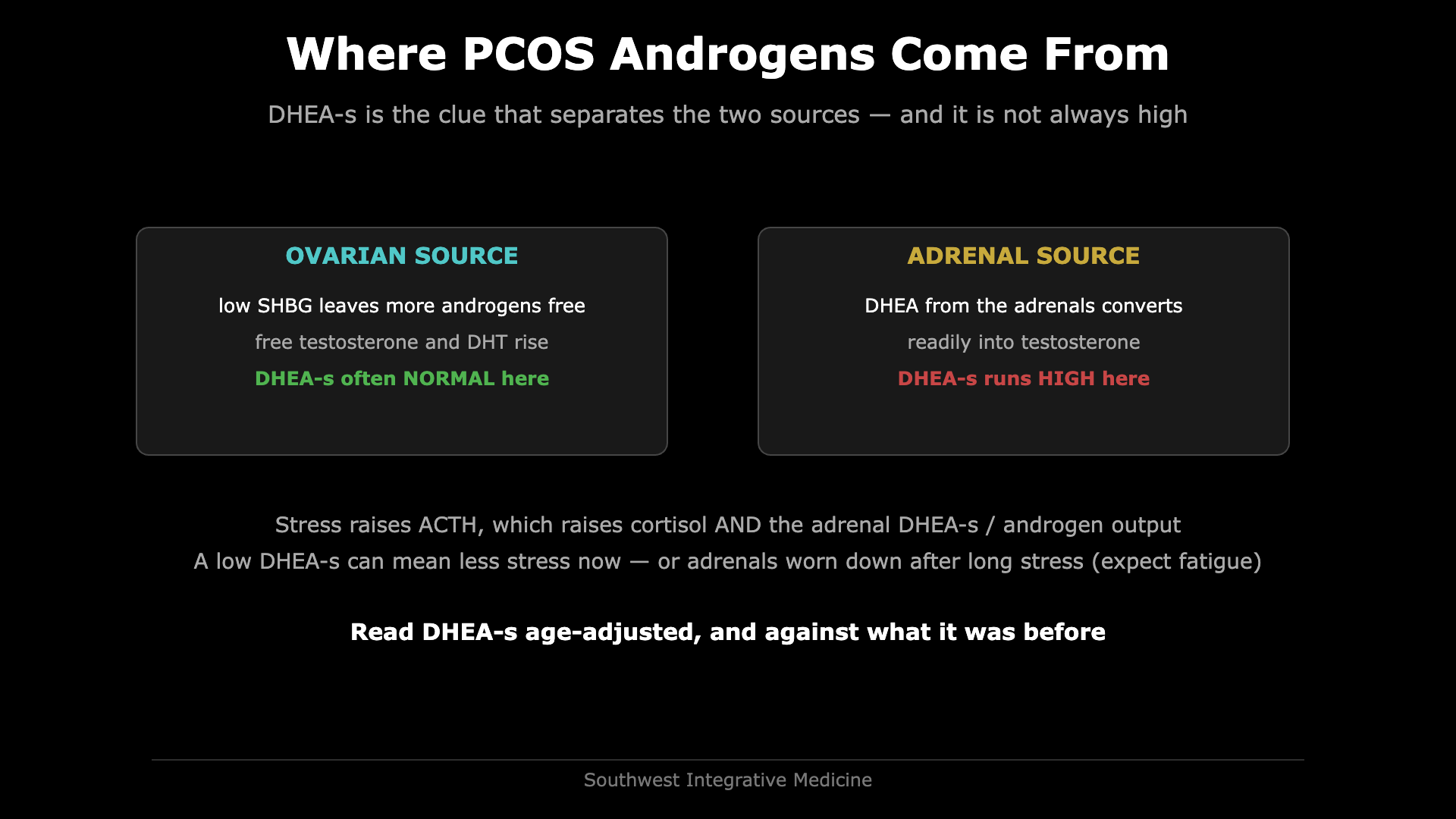
In a previous article we looked at the role of sex hormone binding globulin (SHBG) in PCOS. We said SHBG is typical low which makes androgens more bioavailable. What happens is the low sex hormone binding globulin results in less of the androgens being bound up. This makes more of the androgens free like free testosterone and other androgens like dihydrotestosterone. Not all cases of PCOS are accounted for by simply looking at the sex hormone binding globulin. Sometimes there is high total testosterone and high free testosterone. So we also have to look at what other mechanisms might be able to explain this. In some cases of PCOS the high testosterone is thought to be coming from the adrenal glands.
Androgens like testosterone and dihydrotestosterone can be produced from the adrenal glands for females a significant amount of their androgens do come from the adrenal glands naturally the main precursor for these hormones to be produced in the adrenal glands is DHEA and DHEA can be converted readily converted into testosterone so why would they be getting more androgen production from the adrenal glands all of a sudden what accounts for one female having higher androgen production and another one not well there's not a definitive answer for this but stress seems to be the most likely culprit with stress you can have a direct activity on the pituitary gland there's a feedback loop between the pituitary gland and the adrenals. The pituitary causes a hormone to be produced which then stimulates the adrenals to produce other hormones like androgens.
The hormone that the pituitary gland produces is called ACTH. One of the stimuluses for ACTH to be produced is stress. Higher stress levels can cause ACTH to be produced and then a corresponding increase in things like cortisol. However, along with the cortisol you can also get an increased production of androgens. The ACTH hormone that comes from the pituitary doesn't really differentiate which tissues it stimulates in the adrenal glands. It will stimulate production of cortisol and DHEA. So DHEA is a good way to measure your adrenal androgen output. Make sure you are actually measuring the correct form to give you the most accurate reading. That is DHEA-s or DHEA sulfate versus the plain DHEA.
It's also important to note that the reference ranges for DHEA sulfate should be age adjusted so if you're looking at your reference range and it looks low or high make sure you're looking at the age-related reference ranges so with PCOS we would expect to see high DHEA sulfate level and corresponding androgens like testosterone and dht to also be high. They are not always both high but at least one of them. I have helped many women diagnosed with PCOS produce lower androgens, improve their metabolism and get them ovulating again. Just because you had this diagnosis in the past doesn't mean you'll always have it.
Each time you measure your blood you may get results that are unexpected for someone PCOS, especially if you are treating it. This may explain some of the inconsistent findings many women with PCOS find in their lab results. They expect to see a low sex hormone binding globulin or a high DHEA-s and that may not be there depending on where they're at in their treatment progression.
There are different forms of PCOS too. Not all women are going to have high adrenal output. For instance, Jane asked
"I have PCOS with low sex normal binding globulin but i also have low DHEA. Are these two things related?"
This article is the answer to her. For her i would actually look at the actual levels of DHEA and make sure that it is DHEA sulfate that's being measured. If it is not DHEA sulfate it is a throw out test. You need to have DHEA sulfate. I would also make sure it's age adjusted. Is the DHEA-s low for your age or just low? The actual level here will matter and also what was it before was was it high before and now it's low and what's going on with your health and different things now versus before. Has there been some improvement in your health or changes like a different diet plan or different stress levels? For instance, maybe she was under a lot of stress before and now she's not. As a result she will not get as much ACTH stimulation to the adrenals and therefore less cortisol output. With less cortisol the corresponding DHEA-s and androgen output from the adrenal glands goes down.
Another possibility is she was under a lot of stress for a long period of time, now her adrenal glands aren't able to put out as much of the DHEA -s and cortisol. In this case we would expect her to be more tired as well and this is referred to as adrenal fatigue. All these things can be verified through lab tests. I would also expect her corresponding androgen levels to be low and her free testosterone and free dht high. This is the case when there is low sex hormone binding globulin. Another possibility is that she was recently pregnant and her overall hormone production is decreased.
All these ideas would explain why someone with PCOS would have a low DHEA but typically we would expect DHEA to be high or normal. make sure you're looking at the actual DHEA sulfate levels and the age-adjusted levels of DHEA and if your DHEA is low i would expect your corresponding androgen levels to be low too unless you're supplementing with those androgens okay so that's all i had to say about the relationship between PCOS and DHEA
Related reading: What Does A High DHEA-s In a Female Mean? and High DHEA and Low Cortisol In Female.
If your PCOS labs do not add up and you want help sorting the ovarian from the adrenal picture, schedule an appointment.