







Are you getting some blood test or genetic test back and wondering what you should do about your MTHFR gene mutation? In this article I'm going to cover three simple steps that basically outline how I generally approach helping people with MTHFR gene mutation — some of the labs we test for, some things to watch out for when you're introducing methylfolate, and much more.
A lot of you are getting test results back for your MTHFR gene mutation and wondering what you should do about it. I get a lot of questions on this, and a lot of people are frustrated that they got the result back and now they don't know what to do about it. Sometimes doctors are not really informed or don't understand what this truly means and what to do about it. So I want to walk through what I do with my patients.
Step One: Which Alteration Do You Actually Have?
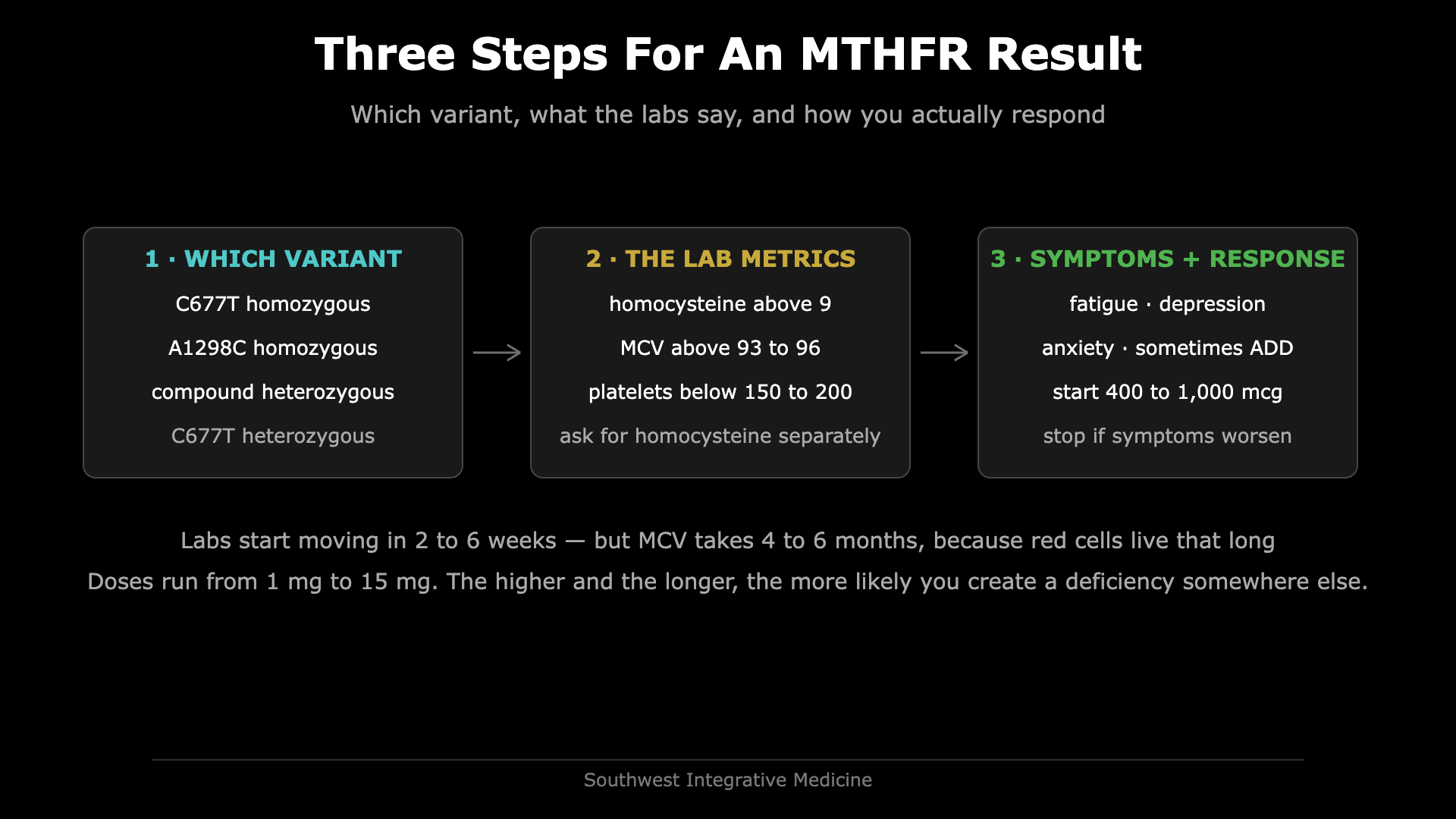
There are three, possibly four, different alterations that really matter here:
- Homozygous for C677T
- Homozygous for A1298C
- One of each — called compound heterozygous for A1298C and C677T
- Heterozygous for C677T
If you don't know what homozygous and heterozygous are, you should look those up, but basically it means how many parents gave you that specific gene alteration — one parent or two. If it's two parents you're homozygous; if it's one parent you're heterozygous. The basic idea is how much alteration is present in your MTHFR gene.
Step Two: Your Lab Metrics
When you're trying to understand what to do about your MTHFR gene alteration, the lab metrics — what your blood work actually shows — do matter. It is going to change how you approach this gene alteration.
There are one or possibly two things that are generally run on a standard lab, and then a third that you probably have to ask for separately. In a standard lab you have your CBC, which contains your MCV blood test and your platelet count. The third thing, which you would have to ask for, is your homocysteine.
So what are you looking for?
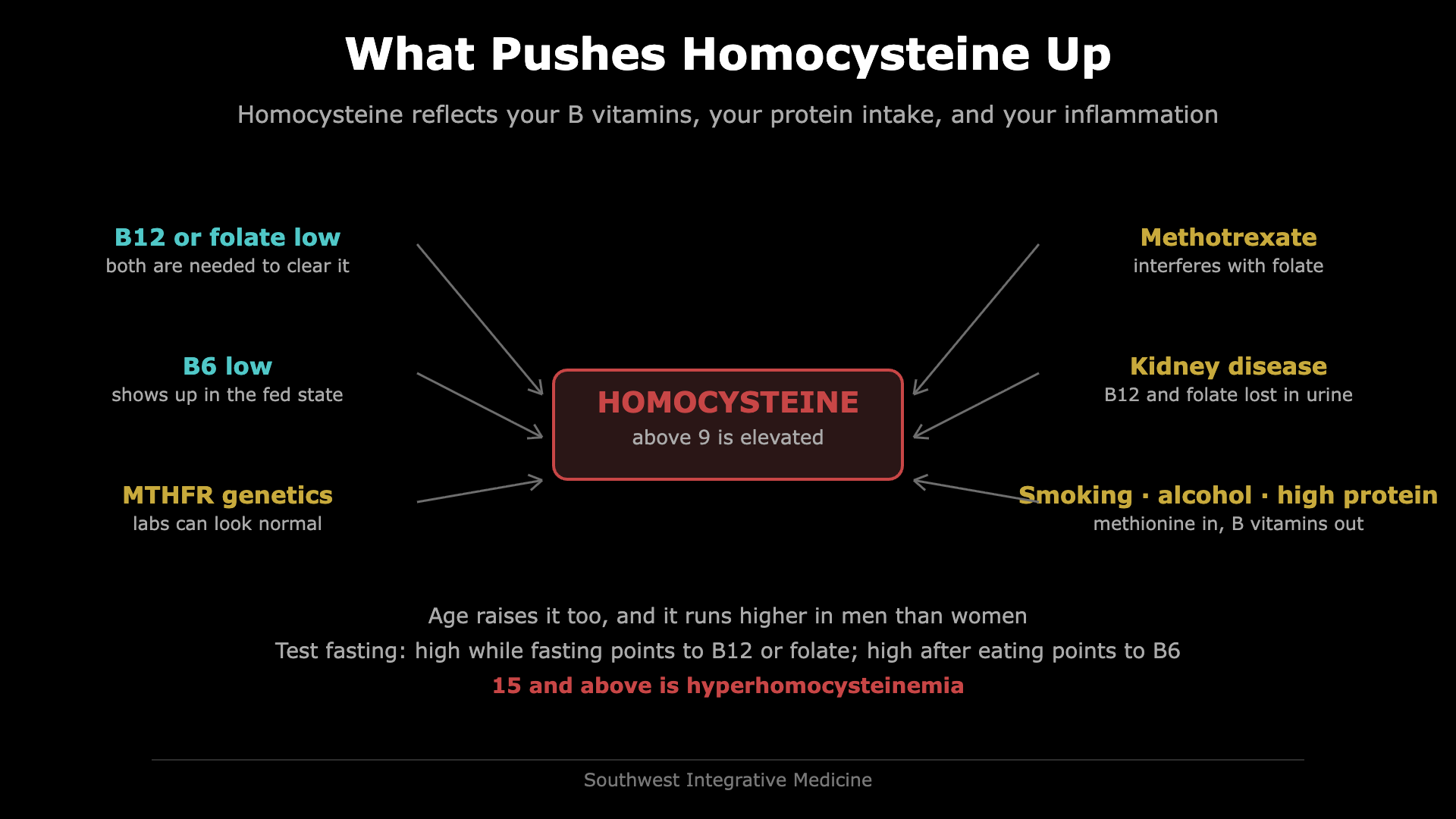
- Homocysteine above 9 — that could be from not enough folate
- MCV above about 93 to 96 — that could also be from not enough folate
- Platelet count below about 150 to 200 — that's a bit low, and has been associated with lack of methylfolate in the MTHFR gene alteration
By the way, when I'm saying folate here I'm specifically referring to methylfolate — but it's also true that if you don't have enough folate of any kind in your body, the same types of things would show up.
The more of these problems showing up in your lab metrics, layered on top of the alteration you have in your actual gene, the more likely it is that your body is asking for more of this methylfolate.
It should be noted that things like homocysteine and MCV can also be elevated for other reasons, such as not enough B12. B12 is a serum blood test you can run, but sometimes that test is misleading — if you're in the upper two-thirds of the lab reference range it's probably not coming from low B12, but it still could be.
Step Three: Your Symptoms, And How You Respond To Methylfolate
The third thing is what your actual symptoms are and how you actually respond to the methylfolate. If you have symptoms suggestive of this MTHFR genetic alteration — fatigue, depression, anxiety, sometimes ADD — these are all good indicators that you may benefit from taking methylfolate.
Like most things in medicine when you're introducing something, you want to start low, go slow, but make sure you take it to its fullest potential. Even though you may have major genetic alterations and labs suggesting you need more folate, it's still better to introduce things slowly so your body has a chance to adjust. In a lot of cases, if you have a major alteration here, your body may not be seeing much of this on a regular basis.
Starting Dose And What To Watch For
A good starting dose is going to be somewhere around 400 to 1,000 micrograms. This is a fairly low dose — if you're someone who's super sensitive, you may want to go even lower.
You can then increase the dose if and when you don't have any worsening of your symptoms or any new symptoms like headaches, anxiety, or trouble sleeping. If you already have these things it doesn't necessarily mean they're going to get worse, but you do want to be extra careful. If these things do occur, that means some kind of problem is happening, you're not tolerating this well, and you need to go back to the drawing board. I have a separate article on why people sometimes feel worse on methylfolate.
Dosing methylfolate can range quite broadly, from 1 milligram to 15 milligrams. The higher the dose, the more likely you're going to see side effects and also create other deficiencies in other areas of your body. These are things you want to look out for if you're on methylfolate long term — the longer you're on it and the higher the dose, the more likely you're going to have a deficiency somewhere else.
How Long Before The Labs Move
As you're on the methylfolate for two, four, six weeks, that's when you would expect to start to see some of those lab metrics changing and improving. The MCV blood test is going to take quite a bit longer, as those red blood cells live for three to four months at a time. So at the end of four months you may start to see the real change — sometimes it can take up to six months to get the full benefit of that added methylfolate.
I should also mention that the MCV blood test, the platelet count and the homocysteine can be influenced by other things outside of just methylfolate and B12. This isn't a one-size-fits-all. You do have to look carefully at all these things, and if things are not matching up well, you might want to go back to the drawing board.
That's the basic concept and idea of how I approach this MTHFR gene alteration in my patients, and it's served me well so far. Make sure you're sharing your entire health picture with your doctor — if they don't know what's going on, they're not going to be able to help you.
If you want to go deeper on this, I have a book and a full course on MTHFR. And if you'd rather work through your own genetics, labs and symptoms with someone, schedule an appointment.