








TRT And High Estrogen: What's Normal And What Is Too High
Let's face it — starting on TRT is like dropping a high-performance engine into your car. Your power's back up. But what happens when your cooling system can't keep up with all that extra power? The engine starts to overheat and things start breaking.
On TRT, your estrogen is kind of like the temperature gauge. For many guys on testosterone, it's often public enemy number one. You're told to block it, crush it, destroy it at all costs. What if I told you this war on estrogen is a big mistake, and it may be the very thing that's causing you to be more tired, have issues with libido, and have more joint aches?
Today we're popping the hood on estrogen so you can stop fearing it and start fine-tuning your system like a master mechanic. By the end of this article you should understand what the science says about high and low estrogen, how to test for it in the right way, and how to find that performance sweet spot for yourself.
You Absolutely Need Estrogen To Feel Good
Here's the biggest thing you really need to internalize about your TRT and estrogen: you absolutely need estrogen to feel good. The goal is not to have zero estrogen. That will make you feel just as miserable as having super high estrogen, if not worse. And we know this from landmark human studies that really analyze and look at this distinction.
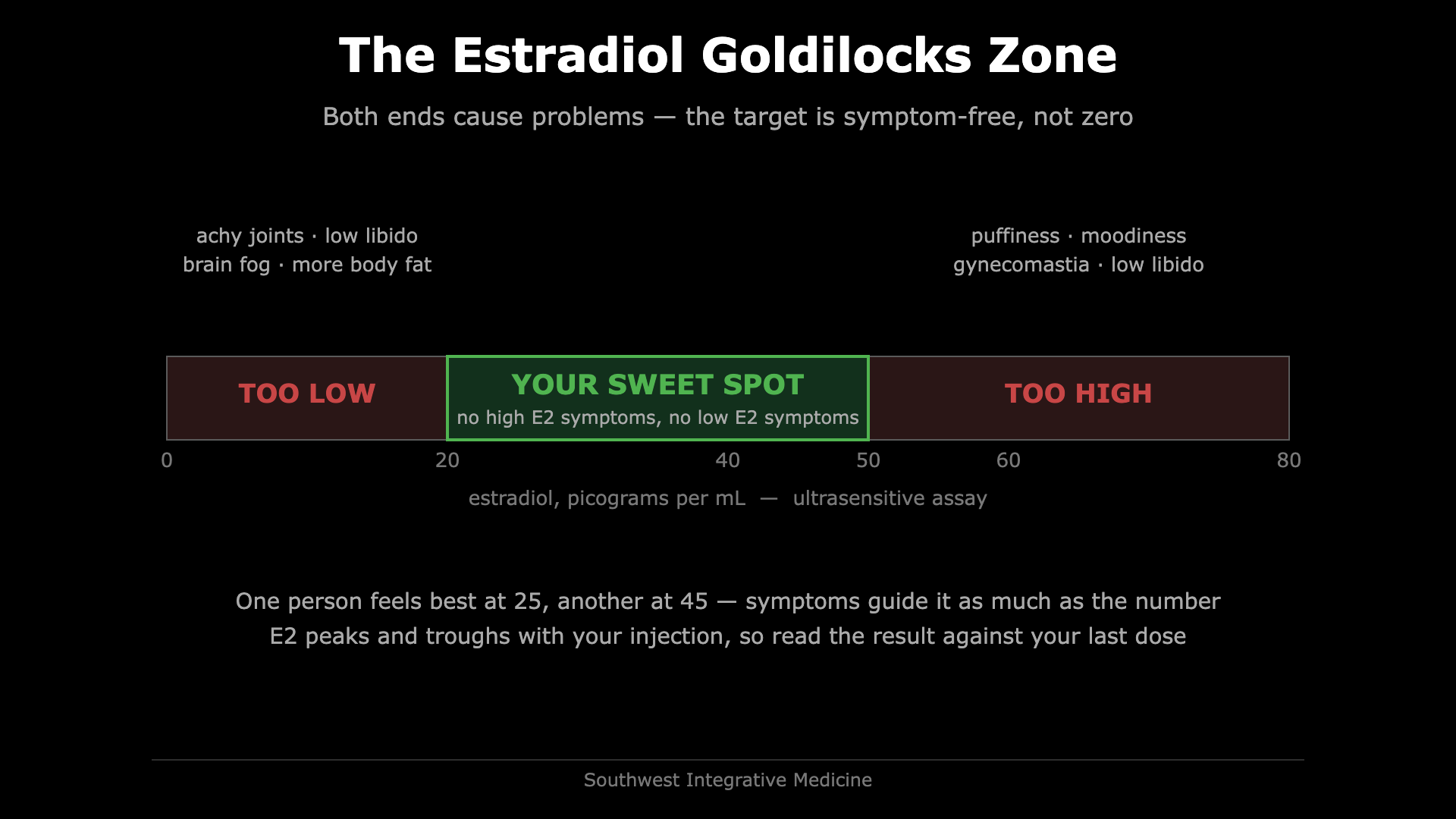
The real goal is finding the optimal balance. Feeling puffy and moody could definitely be from high E2. But having achy joints, maybe super low libido, brain fog — those are also classic signs of super low estrogen, and often come from using estrogen blockers injudiciously and crushing that estrogen. Optimal living and optimal health is going to be found in the middle, not at the extremes.
Why Testosterone Turns Into Estrogen In The First Place
Why does testosterone even turn into estrogen? This is a natural process. Your body uses an enzyme called the aromatase enzyme to convert a portion of that testosterone into estradiol, or E2. The more testosterone in the system, the more estradiol you're going to get — it's basically the raw material for the estrogen to be produced.
So E2 is naturally going to rise with going on testosterone replacement therapy. It's a normal process. The question really is how much is too much, and what do we do in those scenarios.
Symptoms Of High Estradiol
When your testosterone dose is too high, or you're just a high converter of testosterone into estrogen, those levels are definitely going to climb, leading to the classic symptoms of high estradiol:
- Water retention and puffiness — a bloated or puffy face
- Blood pressure issues
- Gynecomastia — puffy or sore nipples, and potentially growth of breast tissue over long periods
- Increased emotional volatility — moodiness, irritability, even crying for no reason or more frequently
- Libido and erectile issues — too much estrogen can impair sexual function, because it has a blocking effect on testosterone too
Symptoms Of Estradiol That's Too Low
This is what happens when men panic and overuse aromatase inhibitors, or perhaps they just got fed some poor advice. They crush their E2 into single digits, and the consequences are sometimes more severe in some than others. I've had people that have low E2 where we've overshot the mark and they don't even really notice it, so it is individually based. But some of the symptoms people do report:
- Painful, achy joints. Estradiol is crucial for joint health — it acts kind of like a lubrication. In fact, a lot of times when men go on testosterone they notice less joint pain, and that's likely from the estradiol levels going up alongside the testosterone.
- Low libido and erectile problems. Without adequate E2, most men will experience very low sex drive.
- Brain fog, anxiety, depression. Very low estrogen can contribute to this — but so can low testosterone, so you have to be careful evaluating all these markers together.
What The New England Journal Study Showed
You may be thinking, how do we actually know this is true? A landmark study published in the New England Journal of Medicine clarified some of these things perfectly. They gave men testosterone, but in some groups they used an estrogen blocker — an aromatase inhibitor — to block the conversion of testosterone into estrogen.
The results were pretty clear. While testosterone itself was primarily responsible for increasing muscle mass and strength, the estradiol was essential for regulating body fat. When E2 was blocked, body fat actually increased. And critically, both testosterone and estradiol were required for normal libido and erectile function — when either was deficient, sexual function went down.
This study pretty much validates that trying to eliminate estrogen is a massive mistake for your health. But that doesn't mean we want sky-high estrogen either.
So What Is The Optimal Level?
This is the million-dollar question. Labs often list the normal range as somewhere around 20 to 40 picograms per mL, but a symptom-plus-lab-based approach is far superior to just looking at a number on the page.
Even more critical: just like your testosterone levels have a peak and a trough after the injection, so does your estradiol. Why? Because E2 is created from testosterone. The higher the testosterone, the more aromatization, and therefore the more E2 you're going to have. As your testosterone falls into the trough before your next injection, so will the E2. Same with the peak.
This means a single estradiol marker is really just a snapshot in time. You have to extrapolate from that one number what else is going on. A high E2 reading at the peak might not be a problem at all if your trough E2 is in a good range and you don't have any high estrogen symptoms. The context is always critical here.
What I like to use is this: your optimal E2 level is the level at which you have no high E2 symptoms and no low E2 symptoms. For one person that might be 25 pg/mL, another might be 45 pg/mL. In my clinic, symptoms are just as important a guide as your lab metrics.
Many clinicians find that monitoring the ratio between total testosterone and estradiol is more useful than looking at E2 in isolation. I don't use this approach — but either way, always use the ultrasensitive estradiol assay for your blood test. This is a more accurate way to check your E2.
The Numbers I Get Concerned About
You may wonder what's absolutely too low and what's absolutely too high. I would say anything below 20 is definitely too low if you're on testosterone and trying to block it. If it just naturally sits at 20, that doesn't mean you need to take extra estrogen.
What's absolutely too high? Above 50 pg/mL is where I start to get more concerned about lowering that E2, even in the context of not having a lot of symptoms. You have to know what the risks and benefits are — if you're fine with the risk, you can let it ride.
The Bottom Line
I think we just need to stop fearing the estradiol. Both high and low levels can cause problems, and the goal is to find the symptom-free, somewhat Goldilocks zone for you. Remember that your E2 level fluctuates, so make sure you're testing and interpreting your results in the context of your last injection.
And since managing high or low estrogen is often a direct result of getting your testosterone dose right in the first place, that's the next thing worth reading. If you haven't sorted out why your testosterone was low to begin with, start with primary versus secondary low testosterone.
Want to see where your estradiol sits relative to everything else? Run your labs through the TRT Lab Analyzer, or schedule an appointment.


